Acesulfame Potassium Now Has a Cancer and Heart Risk Signal
· 7 min read
Written and fact checked by EatMatrix Research Team
Food-additive research team at MAXHUMAN, MB, makers of the EatMatrix scanner
Every claim links to a primary source. Regulatory positions cite EFSA, FDA and WHO/JECFA opinions current at publication.

TL;DR
Acesulfame potassium (E950) is still considered safe by regulators worldwide, and in 2025 EFSA actually raised its acceptable daily intake after reviewing the toxicology again. But two large 2022 French cohort studies linked it to a 13 percent higher cancer risk and a 40 percent higher coronary heart disease risk, and a 2026 lab study found gut bacteria can break it down into byproducts that weakened intestinal barrier integrity in a human cell model. None of this proves it causes those diseases, and dozens of short-term trials find no effect on blood sugar or insulin at all.
Key takeaways
- A 2022 French cohort of 102,865 adults linked acesulfame potassium to a 13% higher cancer risk
- The same researchers found a 40% higher coronary heart disease risk, the largest single sweetener signal
- EFSA raised its acceptable daily intake from 9 to 15 mg per kg in 2025, finding no new hazard
- A 2026 study found gut bacteria can break it into byproducts that weakened a cell model's intestinal barrier
- 36 short-term human trials found no effect on blood sugar or insulin, with or without carbohydrate
Understand the ingredients on your next food label.
Use EatMatrix on your iPhone to scan an ingredient list and explore the ingredient information in the app. Start with a label you already have.
Get EatMatrix for iPhoneOn this page
Acesulfame potassium, E950, is a calorie-free sweetener stirred into diet soda, protein bars and sugar-free yogurt, and its safety has been affirmed by food regulators worldwide.[1] That approval has not moved. What has moved is the evidence: two large French cohort studies published in 2022 linked it to higher cancer and heart disease risk, and in 2025 its own regulator quietly doubled the amount it considers safe to eat every day. Neither fact cancels the other out, and both deserve a straight answer rather than a reassuring shrug.
No regulator has pulled acesulfame potassium from the market, and nothing here suggests you need to scan every label in a panic. But the long-term safety question is more open now than it was five years ago, and the honest version of that story has more nuance than either “it’s fine” or “it’s dangerous.”
What the strongest human evidence shows
The two studies that matter both come from NutriNet-Sante, a French cohort that has tracked tens of thousands of adults since 2009 using repeated 24-hour dietary records, down to the brand name of the product consumed.[2]
- Cancer risk, 2022. Among 102,865 adults followed for a median of 7.8 years, higher consumers of total artificial sweeteners had a 13 percent higher risk of overall cancer. Acesulfame potassium intake specifically carried that same 13 percent higher risk (hazard ratio 1.13).[2]
- Cardiovascular risk, 2022. In a companion analysis of 103,388 participants, acesulfame potassium intake was linked to a 40 percent higher risk of coronary heart disease, the single largest molecule-specific risk figure the researchers reported, while total artificial sweetener intake overall carried a smaller 9 percent higher cardiovascular disease risk.[3]
The number to remember: in the cardiovascular analysis, acesulfame potassium’s own risk figure (40 percent higher coronary heart disease risk) was larger than the headline number for artificial sweeteners as a group (9 percent higher cardiovascular disease risk overall).[3]
102,865 French adults followed for a median of 7.8 years in the cohort linking sweetener intake to cancer risk PMID 35324894
Both findings are observational. The researchers themselves list residual confounding, selection bias and reverse causality as limitations they could not fully rule out, so the results show an association between reported intake and disease risk. They do not prove that acesulfame potassium caused it.[2] The cohort also estimated usual dietary exposure from repeated self-reported dietary records rather than testing a fixed dose, so no randomized trial has compared a set dose of acesulfame potassium against placebo for either outcome.[2]
That is not a dismissal. An association this size, in a cohort this large, with this little else explaining it, is exactly the kind of signal that should trigger a closer look at mechanism, which is where the gut comes in.
Where the signal comes from: what gut bacteria do to it
A decade of research on a related sweetener set up the question. A widely cited 2014 Nature study found that saccharin altered gut microbiota composition and induced glucose intolerance in mice, an effect reproduced by transplanting the altered microbiota into germ-free mice and, in a small way, observed in humans too.[4] That finding opened a line of inquiry researchers have since run on other sweeteners, including acesulfame potassium.
In mice, four weeks of acesulfame potassium consumption shifted gut bacterial community composition and increased body weight gain, an effect seen in male but not female mice.[5]
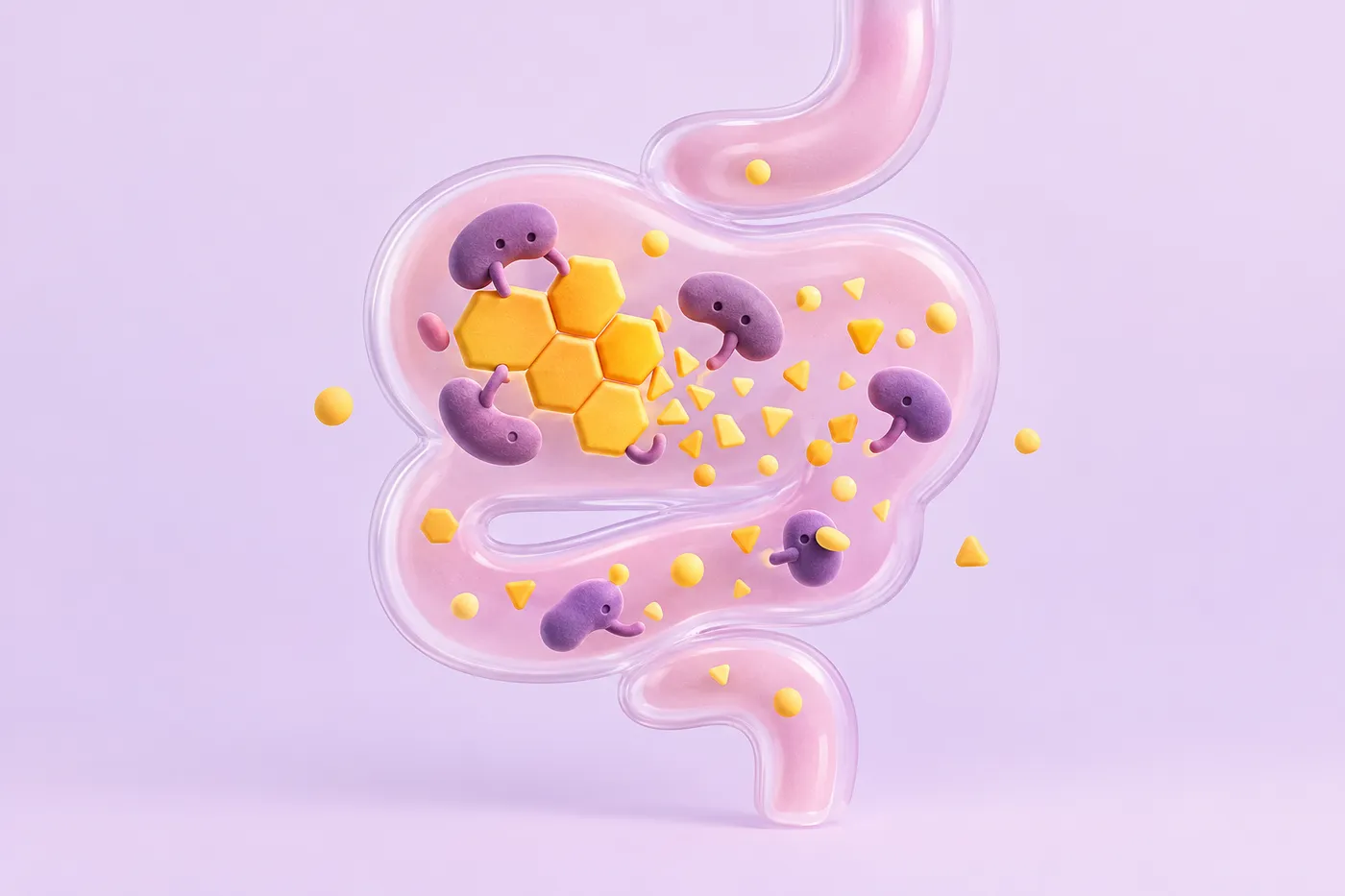
The more specific mechanism is newer. Gut bacteria can degrade acesulfame potassium into byproducts including sulfamate and acetoacetate. A 2026 study found that this bacterial breakdown produced a dose-dependent decrease in intestinal epithelial barrier integrity in a human cell model.[6]
The familiar part of this story is fermentation. Gut bacteria do something similar to dietary fiber constantly, breaking down what reaches the colon intact into short-chain fatty acids like butyrate, usually the reason fiber is good for the gut lining. The 2026 study found the same signature molecule, butyrate, rising alongside acesulfame potassium exposure. The surprise is that barrier integrity dropped anyway, which points to the broader mix of sulfated byproducts as the likely culprit, with butyrate itself an unlikely explanation on its own.[6]
That effect has so far been shown only in a simulated gut system paired with a human intestinal cell model, not yet confirmed inside a living animal or human gut.[6]
The dose rules just changed
Here is the detail most coverage of this sweetener is still missing: the regulatory ground moved under this question in 2025.
EFSA re-evaluated acesulfame potassium that year and raised its acceptable daily intake from 9 to 15 milligrams per kilogram of body weight per day, concluding there were no new safety concerns, including for the sweetener’s own chemical degradation products.[7] That revised 15 mg/kg figure now matches the acceptable daily intake the Joint FAO/WHO Expert Committee on Food Additives had already set, so the two bodies no longer disagree on the number.[7]
Acceptable daily intake, before and after
| Body | Acceptable daily intake | Status |
|---|---|---|
| EFSA (pre-2025) | 9 mg/kg/day | Superseded |
| EFSA (2025 re-evaluation) | 15 mg/kg/day | Current |
| JECFA | 15 mg/kg/day | Unchanged, now matches EFSA |
Milligrams per kilogram of body weight per day.
Raising a regulatory limit sounds alarming on its own, but the direction of travel matters: EFSA’s panel widened the margin after reviewing the toxicology again, without finding a new hazard. The acceptable daily intake is a ceiling built from animal dosing studies with a large safety margin applied, and it sits well above typical exposure rather than marking where harm begins.[7]
What this doesn’t prove yet
No randomized controlled trial in humans has demonstrated that acesulfame potassium causes cancer or cardiovascular disease at the doses typically consumed in food and drinks.
The short-term human trial evidence on the most testable mechanism, blood sugar and insulin response, points the other way entirely. A 2023 systematic review and network meta-analysis of 36 short-term trials found that beverages sweetened with acesulfame potassium and other non-nutritive sweeteners produced no measurable change in blood glucose, insulin or related gut hormones compared with water, whether consumed alone or together with carbohydrate.[8]
That is worth sitting with: the one mechanism short-term human trials can test, acute blood sugar response, keeps coming back negative, while the signal that keeps showing up is in long-term cohort data and gut-microbiome experiments, not in a lab measuring your blood after a drink.
- What’s established: an observational link to cancer and coronary heart disease risk in one large cohort; a plausible gut-bacterial mechanism shown in cell and simulated-gut models; no acute blood sugar effect in dozens of short trials.
- What’s not established: causation; the effect of gut-bacterial degradation inside a living gut; any dose threshold at which the cohort-level risk appears.
Is acesulfame potassium worse than other sweeteners?
Not clearly, and that matters for how worried to be.
In the cohort’s cancer analysis, aspartame’s risk increase was slightly larger than acesulfame potassium’s (hazard ratio 1.15 versus 1.13), but in the companion cardiovascular analysis acesulfame potassium carried the single largest molecule-specific risk figure of the three sweeteners studied (coronary heart disease hazard ratio 1.40, ahead of aspartame’s cerebrovascular hazard ratio of 1.17), so acesulfame potassium is not uniquely implicated among artificial sweeteners.[2][3]
Molecule-specific risk ratios in the French cohort
Hazard ratios from two 2022 NutriNet-Sante analyses.
Zoom out and the regulatory picture across non-sugar sweeteners is genuinely unsettled well beyond this one molecule. In 2023 the World Health Organization released a guideline on non-sugar sweeteners, including acesulfame potassium, after its own systematic review found that while short-term randomized trials showed some benefit, long-term prospective cohort studies linked their use to potential cardio-metabolic harm that could not be ruled out.[9]
This is not a uniquely acesulfame potassium problem. It is the same pattern playing out across the whole sweetener category, the way different regulators landed in different places on monk fruit extract, cleared in the US and blocked in the EU, even though it is not chemically related to acesulfame potassium at all. Sweeteners are being judged one molecule at a time, on evidence that keeps arriving out of order.
What to watch for
Confirming or ruling out the cohort associations will require prospective studies that measure acesulfame potassium exposure directly, through blood or urine biomarkers, rather than relying on self-reported dietary recall.
The more immediate open question is narrower: does the gut-bacterial degradation effect on intestinal barrier integrity hold up inside a living gut, not just in a simulated system and a cell model. That is the next experiment this specific finding calls for, and it has not been run yet.[6]
Bottom line: acesulfame potassium remains approved, and its regulator just raised the amount it considers safe after reviewing the toxicology again in 2025. But two large 2022 cohort studies linked it to higher cancer and coronary heart disease risk, a 2026 lab study showed a real mechanism for gut-level harm, and neither has been tested the way that would settle the question: a trial that tracks a fixed dose over years rather than a single drink and a blood draw. Until that trial exists, “approved” and “worth watching” are both true at once.
If you are trying to cut back while you wait for better evidence, the EatMatrix app reads a label with no barcode needed and flags acesulfame potassium and the other sweeteners in this piece by name, so you can see exactly where they show up before you decide whether that matters to you.
This article summarises publicly available regulatory assessments and peer-reviewed research about food ingredients. It is general information and is not intended to diagnose, treat, cure, or prevent any disease, and it is not personalised dietary or medical advice. Regulatory positions change; the EatMatrix app reflects the current assessments in our database. If you have an allergy, a medical condition, or are pregnant, talk to a qualified clinician or dietitian before changing what you eat.
References
- Biological fate of low-calorie sweeteners.. Nutrition reviews, 2016.
- Artificial sweeteners and cancer risk: Results from the NutriNet-Santé population-based cohort study.. PLoS medicine, 2022.
- Artificial sweeteners and risk of cardiovascular diseases: results from the prospective NutriNet-Santé cohort.. BMJ (Clinical research ed.), 2022.
- Artificial sweeteners induce glucose intolerance by altering the gut microbiota.. Nature, 2014.
- The artificial sweetener acesulfame potassium affects the gut microbiome and body weight gain in CD-1 mice.. PloS one, 2017.
- Human Gut Microbiome Can Degrade the Sweetener Acesulfame K with Potential Damaging Effects in the Intestinal Barrier Function.. Journal of Agricultural and Food Chemistry, 2026.
- Re-evaluation of acesulfame K (E 950) as food additive.. EFSA Journal, 2025.
- The Effect of Non-Nutritive Sweetened Beverages on Postprandial Glycemic and Endocrine Responses: A Systematic Review and Network Meta-Analysis.. Nutrients, 2023.
- Non-sugar sweeteners and health outcomes in adults without diabetes: deciphering the WHO recommendations in the Indian context.. Diabetes & metabolic syndrome, 2023.
Frequently asked questions
Is acesulfame potassium safe to eat?⌄
Food regulators worldwide still consider it safe, and EFSA raised its acceptable daily intake in 2025 after reviewing the toxicology again and finding no new hazard. But two large 2022 cohort studies linked it to higher cancer and coronary heart disease risk, an association that has not been tested in a randomized trial.
Does acesulfame potassium cause cancer?⌄
No randomized controlled trial has shown that it causes cancer. A 2022 French cohort study found higher acesulfame potassium intake was associated with a 13 percent higher risk of overall cancer, but that is an association from self-reported dietary data, not proof of cause.
What is acesulfame potassium's acceptable daily intake?⌄
EFSA raised it from 9 to 15 milligrams per kilogram of body weight per day in 2025, a figure that now matches what the Joint FAO/WHO Expert Committee on Food Additives had already set.
Does acesulfame potassium affect gut bacteria?⌄
Yes. Mouse studies have shown it shifts gut bacterial composition, and a 2026 study found gut bacteria can break it down into byproducts that weakened intestinal barrier integrity in a human cell model, though this has not yet been confirmed inside a living gut.
Is acesulfame potassium worse than aspartame?⌄
Not clearly. In the same French cohort, aspartame carried a slightly higher cancer risk, while acesulfame potassium carried the largest single coronary heart disease risk figure of the sweeteners studied, so neither one is consistently worse.
More like this, by email
A weekly email with our new research-backed guides. No spam, unsubscribe any time.


