Yuka vs Fooducate: which one the science backs
· 6 min read
Written and fact checked by EatMatrix Research Team
Food-additive research team at MAXHUMAN, MB, makers of the EatMatrix scanner
Every claim links to a primary source. Regulatory positions cite EFSA, FDA and WHO/JECFA opinions current at publication.
TL;DR
Yuka scores food 0 to 100 using Nutri-Score nutrition data plus an additive risk layer based on EFSA and IARC assessments, while Fooducate assigns an A to D grade from the US nutrition facts panel and ingredient list with no additive-risk layer. Neither app has published trial evidence that using it changes what people actually eat, though the Nutri-Score logic behind Yuka's nutrition score does have randomized trial support. Choose Yuka for additive transparency in Europe, choose Fooducate for US nutrition-facts grading folded into meal tracking.
Key takeaways
- Yuka weighs 60% Nutri-Score nutrition, 30% additive risk, 10% organic status, capping high-risk-additive products at 49/100
- Fooducate grades A to D from the US nutrition facts panel and ingredient list, with no additive-risk layer
- A 2024 review of 55 studies found barcode-and-score apps like these are rarely evaluated in trials, and neither Yuka nor Fooducate is named in it
- Nutri-Score, behind 60% of Yuka's score, has randomized controlled trial support in French shoppers for reducing ultra-processed purchases
- EFSA's re-evaluation of titanium dioxide (E171), an additive Yuka flags, found genotoxicity risk could not be ruled out, leading to an EU food ban
On this page
Yuka and Fooducate both turn a phone camera into a verdict on your groceries, but they are not measuring the same thing, and neither has been tested in a trial that proves it changes what you eat. Yuka’s score leans on Nutri-Score nutrition data plus an additive risk layer pulled from EU and international regulatory opinions. Fooducate’s grade comes from the US nutrition facts panel and ingredient list, with no additive-by-additive regulatory check at all.
If additives are what worry you, Yuka is the more rigorous tool. If the nutrition facts panel and processing level are the concern, especially on US packaging, Fooducate does that job and folds it into meal tracking.
Neither claim rests on evidence that the app itself improves health outcomes. That gap is the real story here, and it is worth being specific about where it comes from.
What each app measures
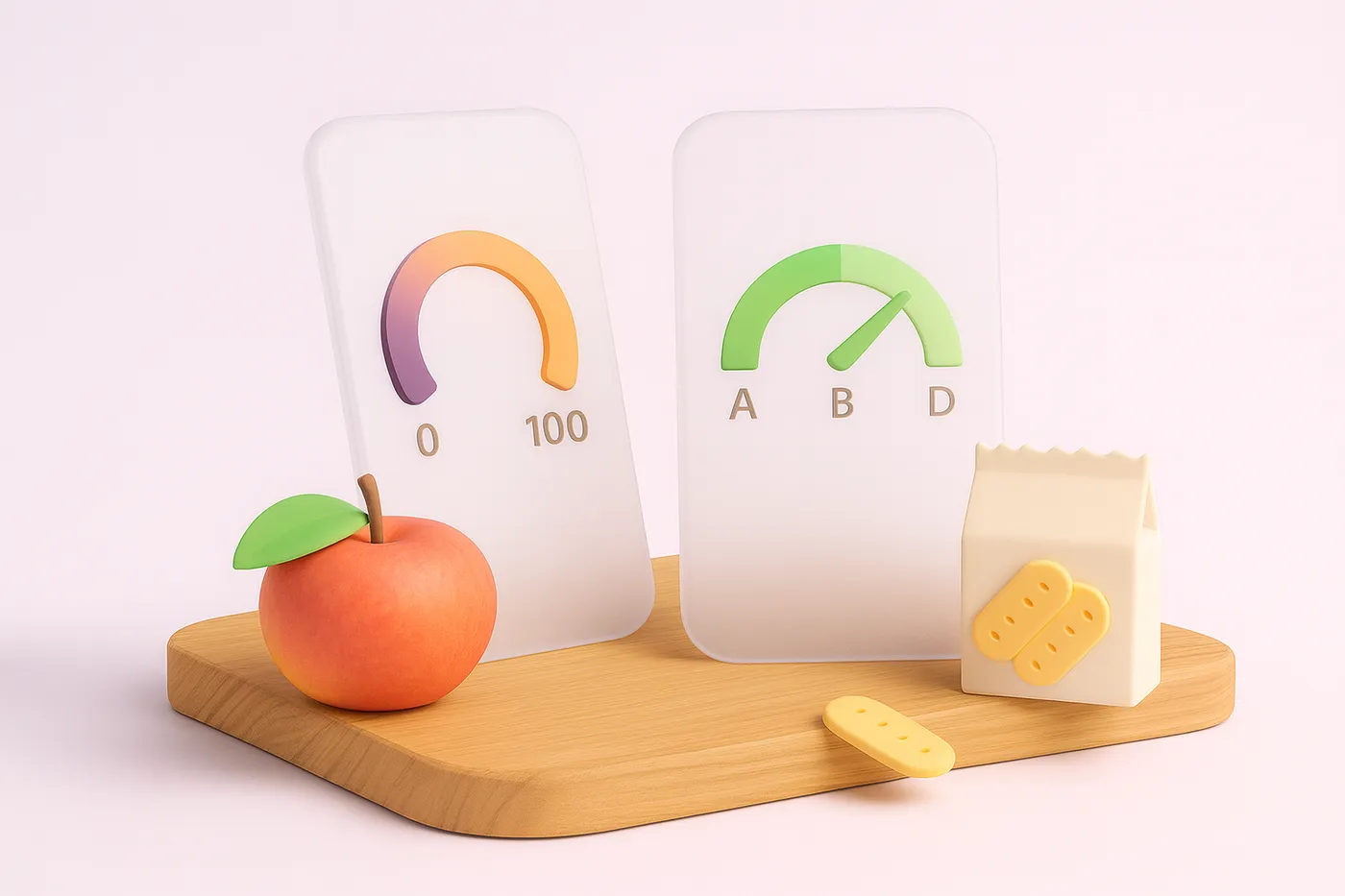
Yuka launched in France in 2017. It scores a scanned product from 0 to 100, weighted 60% on Nutri-Score nutrition quality, 30% on additive risk drawn from EFSA and IARC assessments, and 10% on organic certification. If a product contains an additive Yuka classifies as high risk, the score is capped at 49 regardless of how the rest of the product looks nutritionally.
Fooducate has been running since 2010 and is built for the US market. It assigns an A to D letter grade from the nutrition facts panel and ingredient list, rewarding minimally processed, nutrient-dense foods over heavily processed ones. There is no separate additive-risk layer tied to EFSA, IARC or FDA re-evaluations. Two products with identical nutrition facts panels can land on the same grade even if one of them contains an additive currently under regulatory review somewhere in the world.
Head to head: what the evidence on effectiveness shows
This is where the comparison gets honest instead of promotional.
A 2024 scoping review pulled together 55 studies covering 46 food purchase apps.[1] It found that apps built around scanning a barcode and displaying a rating, exactly what Yuka and Fooducate both do, made up 59% of every app design studied. Despite being the most common design, that category was evaluated for behavioral impact less often than other app types, and the studies that did test it produced mixed results.[1]
Of the full set of 55 studies, only 11 were comparative evaluation trials measuring behavior change rather than just describing an app’s design or feasibility.[1] The apps named in that review include FoodSwitch, EcoPanel and FutureMe. Yuka and Fooducate are not among them.
11 of 55 published studies on food purchase apps were trials measuring actual behavior change PMID 38446500
That does not mean the underlying idea is untested, only that these two specific apps are.
Nutri-Score, the layer behind 60% of Yuka’s score, has real trial data behind it. A post-hoc analysis pooling three French randomized controlled trials, run in students, low-income adults and people with cardiometabolic disease, found that shopping carts in the Nutri-Score arm contained a significantly higher proportion of unpacked, unprocessed foods and fewer ultra-processed purchases than carts with no label or a Reference Intakes label.[2] That is evidence for the nutrition half of Yuka’s formula. It says nothing about Yuka the product, which has never been tested this way.
Other barcode-scanning apps have been through the same kind of testing that Yuka and Fooducate have not. SwapSHOP, a UK app that scans grocery barcodes and suggests healthier swaps, was tested in a feasibility randomized controlled trial with 112 participants.[3] The intervention group cut saturated fat by 0.56 grams per 100 grams and total sugars by 1 gram per 100 grams in their purchases compared to the control group, a result the authors called suggestive enough to justify a full trial.[3]
What the evidence establishes: the nutrition-labeling logic behind Yuka’s score has RCT support. The additive-scoring logic and the app itself, on either side, do not have a published trial. That is an absence of evidence. It says nothing about whether the apps work.
Head to head: how each handles additive and regulatory risk
Yuka’s additive layer is the more defensible half of the comparison, and it has a real regulatory record behind it. Take titanium dioxide (E171), an additive Yuka’s risk model flags as high risk. EFSA’s re-evaluation raised genotoxicity concerns it could not rule out, and the additive has been banned from food use across the EU since 2022.[4] That is a concrete example of Yuka’s additive scoring lining up with a regulator’s own published conclusion, a fact readers can check against the source, rather than a vague “hidden dangers” warning.
The tradeoff is that Yuka’s cap mechanism is blunt. Because any product with a high-risk additive is capped at 49 out of 100, a product with a strong nutritional profile can still read as “bad” purely on additive grounds. That is a deliberate design choice: it prioritizes additive avoidance over overall diet quality, and a shopper who cares more about sugar and fiber than about additive regulatory status should know that going in.
The honest downside: Yuka’s cap can rate a nutritionally strong product as “bad” purely because of one flagged additive. The score is built to answer an additive question first and a whole-diet question second.
Fooducate does not run this additive check at all. Its grade is a nutrition-facts-and-ingredients read, useful and specific to the US label format, but it will not tell you that an additive is under active review in Brussels the way Yuka’s score does.
The practical difference comes down to which regulatory system backs the data you’re reading:
- Yuka’s additive layer is most reliable on products sold in Europe, where its regulatory anchors (EFSA, IARC) apply directly.
- Fooducate’s grade is most reliable on US packaging, where its nutrition-facts format and database are built for the label in your hand.
Practical considerations
Yuka vs Fooducate at a glance
| Yuka | Fooducate | |
|---|---|---|
| Score type | 0 to 100 numeric | A to D letter grade |
| What it weighs | 60% Nutri-Score nutrition, 30% additive risk, 10% organic | Nutrition facts panel and ingredient list |
| Regional strength | Europe (EU/international regulatory data) | United States (US nutrition-facts format) |
| Database size | ~4 million products, ~1,200 added daily | US-focused, smaller international coverage |
| Languages | Six | English-focused |
| Free tier | Unlimited scans, full score | Free grading; coaching and meal tracking sold separately |
| Premium cost | About $10 to $20 a year (offline mode, search, dietary alerts) | Around $40 for lifetime access in many current promotions |
A feature comparison only.
Yuka’s free tier already includes unlimited scans and the full score. Premium adds offline mode, a search function, and dietary alerts for things like gluten, lactose or palm oil, for roughly $10 to $20 a year depending on region.
Fooducate’s grading is free, but its meal-tracking and coaching features are sold as a separate premium tier, often through lifetime-access promotions priced around $40 rather than a recurring annual fee.
Choose Yuka if, choose Fooducate if
The verdict changes depending on what you’re trying to avoid or track.
Choose Yuka if
- The additive list is what worries you most: EU-restricted preservatives, colorants or emulsifiers.
- You shop in a market where Yuka’s database and six-language coverage are strongest.
- You want a single number that folds nutrition and additive status together.
Choose Fooducate if
- The nutrition facts panel, added sugar, and degree of processing are your bigger concern.
- You’re buying mostly US packaged foods.
- You want grading built into a calorie and meal-tracking habit you already use.
For a wider set of options beyond these two, EatMatrix’s own comparison of food scanner apps covers how the field stacks up on the evidence. And if it’s specifically Yuka’s own track record you’re trying to weigh, this breakdown of what’s proven and what isn’t goes deeper on that half of the picture.

Bottom line
Neither app has published trial evidence proving it changes what people eat. Judged on what each app is built to do, Yuka wins on additive-risk transparency anchored to real EFSA and IARC assessments, and Fooducate wins on US nutrition-facts grading built into a tracking habit.
Bottom line: Yuka is the stronger pick if additive risk is your question, backed by EFSA’s own findings. Fooducate is the stronger pick if nutrition facts and processing level are your question, backed by a bigger US database. Neither has proof it changes what you eat, only proof of what it measures.
A number or a letter compresses a lot of nuance into one glance. Treat either score as a starting point, then read the ingredient list yourself. And if you want a scanner that reads the ingredient panel itself with no barcode required, personalised to your own allergens and diet, that is what the EatMatrix app is built for.
This article summarises publicly available regulatory assessments and peer-reviewed research about food ingredients. It is general information and is not intended to diagnose, treat, cure, or prevent any disease, and it is not personalised dietary or medical advice. Regulatory positions change; the EatMatrix app reflects the current assessments in our database. If you have an allergy, a medical condition, or are pregnant, talk to a qualified clinician or dietitian before changing what you eat.
References
- Smartphone Apps for Food Purchase Choices: Scoping Review of Designs, Opportunities, and Challenges.. Journal of medical Internet research, 2024.
- The impact of the Nutri-Score front-of-pack nutrition label on purchasing intentions of unprocessed and processed foods: post-hoc analyses from three randomized controlled trials.. The international journal of behavioral nutrition and physical activity, 2021.
- A Behaviorally Informed Mobile App to Improve the Nutritional Quality of Grocery Shopping (SwapSHOP): Feasibility Randomized Controlled Trial.. JMIR mHealth and uHealth, 2024.
- EFSA prohibits titanium dioxide in food- should pharmaceuticals be next?. Toxicology, 2025.
Frequently asked questions
Is Yuka or Fooducate more accurate?⌄
They measure different things, so accuracy depends on what you want. Yuka's additive scoring is anchored to EFSA and IARC assessments and is most reliable in Europe, while Fooducate's nutrition facts grading is built for US packaging.
Has Yuka been proven to improve diet or health?⌄
No published trial has tested Yuka itself. A 2024 scoping review of 55 studies on food purchase apps does not name Yuka among the apps evaluated, though the Nutri-Score nutrition logic behind 60% of its score does have randomized trial support.
Does Fooducate check food additives against EFSA or FDA safety reviews?⌄
No. Fooducate's grade comes from the nutrition facts panel and ingredient list, with no additive-by-additive regulatory layer tied to EFSA, IARC or FDA re-evaluations.
Why does Yuka rate some products as bad even if they look nutritionally fine?⌄
Yuka caps any product containing a high-risk additive at 49 out of 100 regardless of its nutrition profile, a design choice that prioritizes additive avoidance over overall diet quality.
Is Yuka or Fooducate better for US shoppers?⌄
Fooducate is US-focused and built around the US nutrition facts panel, while Yuka's additive-risk layer depends on EU and international regulatory opinions, making it most reliable on products sold in Europe.
More like this, by email
New research-backed guides and additive verdict changes. No spam.