Best AI Calorie Counter Apps vs Manual Logging: Which One Sticks
· 7 min read
Written and fact checked by EatMatrix Research Team
Food-additive research team at MAXHUMAN, MB, makers of the EatMatrix scanner
Every claim links to a primary source. Regulatory positions cite EFSA, FDA and WHO/JECFA opinions current at publication.

TL;DR
An AI calorie counter is not more accurate than careful manual logging, it is just easier to keep doing. Photo based AI apps show estimation errors ranging from about 0.1% to 38% in validation studies, while manual food diaries consistently underreport intake, so the real choice comes down to which error you can live with and which habit you will actually keep up.
Key takeaways
- AI photo apps show inconsistent errors, from near exact to about 38% off, in a 52 study review
- Manual food diaries consistently underreport intake, by roughly 1,300 to 3,400 kilojoules a day
- Calorie tracking app use is associated with disordered eating symptoms in some users, but causation is unproven
- A 12 week smartphone tracking trial found 2.4 to 2.8 kg average weight loss across tracking methods
- Few digital self-monitoring trials keep participants logging on 75% or more of days
On this page
An AI calorie counter is not a more accurate scale than a careful manual food log. It is an easier habit to keep.
That is the actual trade the research supports, and it is a different trade than the marketing for either side admits. Photo based AI apps promise to remove the tedium of searching a food database, and they do, but validation studies still find real estimation error between what the camera sees and what a person ate. Manual logging promises precision, and a diligent entry can be precise, but decades of doubly labeled water studies show that self-reported diaries systematically undercount what people eat, often without the person noticing. Neither method hands you a true number. The question that decides which one is right for you is which error you can live with, and which habit you will still be doing in month three.
Who wins: if you have quit manual logging before because typing every meal felt like a chore, an AI calorie counter is the app that gets you tracking again, even with its own error built in. If you need precise macronutrient control, for a diagnosed condition or a specific performance goal, a detailed manual log with a good food database still gives you finer control than a photo estimate.
What an AI calorie counter does, and what manual logging does
The two approaches solve the same problem in opposite ways.
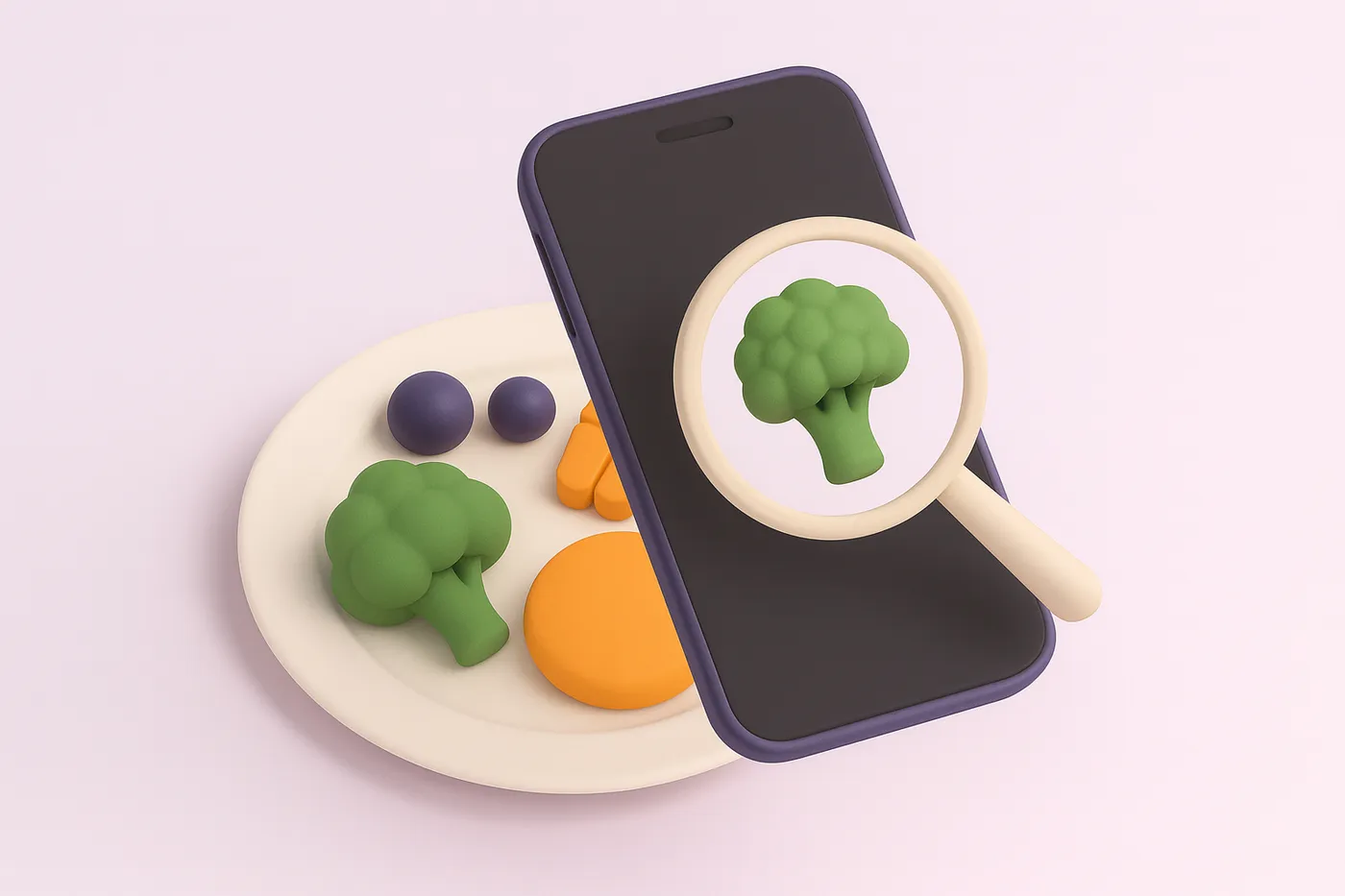
- AI calorie counter apps run a computer vision model, usually a convolutional neural network, on a photograph. The model has to do three things in sequence: segment the food items in the frame, classify what each one is, and then estimate its volume, calories or nutrients from that classification.[1] There is no manual data entry. The tradeoff is that the app is guessing at portion size from a 2D image, and that guess is where the error tends to concentrate.
- Manual logging apps rely on the user searching a food database and entering a portion size themselves. Accuracy depends entirely on database quality and how carefully the person measures or estimates that portion. There is no computer vision step to get wrong, but there is also no shortcut: every entry takes real time and real honesty.
Neither is a scale. Both are estimates of what a scale would say.
Head to head: measurement accuracy
This is the outcome that matters, and it is where both methods have documented, specific failure points.
AI photo estimation. A systematic review of 52 validation studies published between 2010 and 2023 compared AI based digital image dietary assessment to human assessors and ground truth measures like weighed food and doubly labeled water. Average relative calorie errors across the included systems ranged from about 0.1% to 38.3%, a wide and inconsistent spread that the reviewers could not pool into a single number because the studies measured accuracy so differently.[2]
38.3% the high end of average calorie estimation error found across 52 AI photo app validation studies PMID 38060823
That range is not a fluke of one bad app. A separate validation of a mobile AI dietary assessment app called FRANI, tested against weighed food records in adolescent females in Ghana eating their normal diet over several non-consecutive days rather than a fixed lab meal, found the app’s energy estimates were equivalent to weighed records within a 10% error margin, roughly the same accuracy range as a traditional 24-hour recall interview.[3] In other words, the best performing AI tools are landing in the same accuracy neighborhood as the manual recall methods they are supposed to replace. They are not clearly beating them yet.
Manual self-report. The failure mode here is different: not scatter, but a consistent downward bias. A meta-analysis of 31 studies covering more than 4,500 adults compared self-reported energy intake to doubly labeled water measured energy expenditure and found underestimation across every single dietary assessment method tested, by roughly 1,300 to 3,400 kilojoules a day depending on the method, with no meaningful difference by sex except for estimated food records.[4]
This is not a new finding. In a landmark 1992 study, researchers gave obese patients who reported eating under 1,200 calories a day, and were not losing weight, a doubly labeled water test and 14 days of indirect calorimetry to measure what they ate. Their energy expenditure was normal for their body composition. The gap was in what they reported versus what they consumed: they had substantially underreported their intake.[5]
The core asymmetry: AI apps tend to be inconsistently wrong, sometimes close, sometimes off by over a third. Manual logs tend to be consistently wrong in one direction, low. Averaging more days of either method does not cancel out an error that is systematic rather than random.
Head to head: psychological safety
Accuracy is not the only outcome worth comparing. Both methods sit inside apps that ask a person to think about food constantly, and that habit is not free for everyone.
A survey of 1,357 adults found that 71% had used a calorie tracking app at some point. People who used it specifically for weight control or shape reasons, rather than general health or disease prevention, were more likely to report that the app contributed to symptoms like food preoccupation, all-or-none thinking about food, food anxiety and purging behavior than people using it for health reasons.[6]
A 2025 systematic review of 27 studies on fitness and diet tracker use found a reasonably consistent cross-sectional association between tracker use and disordered eating outcomes, including dietary restraint and excessive exercise. But that association did not hold up in the smaller body of experimental research on the topic, and the reviewers were explicit that it is not currently possible to say tracker use causes disordered eating, or which direction the relationship runs.[7]
That distinction matters and it is easy to blur. These are cross-sectional, observational findings: people who already struggle with food are more likely to be found using a calorie counting app, and using an app in certain ways is associated with worse symptoms in the same snapshot of data. Neither pattern tells you that the app caused the symptom. No published trial has directly compared an AI photo based calorie counter against manual entry logging for this specific risk, so there is currently no evidence that one format is safer than the other on this axis.
Head to head: adherence and real world weight outcomes
An estimate you stop using is worthless no matter how accurate it would have been on day one, which is why engagement matters as much as precision.
A randomized trial of 105 adults with overweight or obesity used the MyFitnessPal app for daily self-monitoring with a tailored calorie goal over 12 weeks, testing three different orders for introducing diet and weight tracking. Weight loss at three months ranged from 2.4 to 2.8 kilograms across the three arms, with no significant difference between them. The trial’s authors described this as clinically meaningful weight loss from a stand-alone digital tracking intervention, regardless of the specific sequence used.[8]
-2.7 kg average weight loss over 12 weeks in a smartphone self-monitoring trial, across tracking sequences PMID 30816851
The harder problem is keeping people doing it. A systematic review of 39 randomized controlled trials of digital self-monitoring in weight loss programs found that few interventions managed to keep participants logging on 75% or more of days, even though digital tracking still beat paper logging in most direct comparisons.[9] An older review of 22 weight loss studies found a consistent association between how often someone self-monitored, regardless of which method they used, and how much weight they lost, though the review’s authors rated that evidence as weak because of methodological limitations in the underlying studies.[10]
None of these trials isolate AI photo apps specifically against manual entry apps on long-term adherence. What they establish is the more general pattern: digital tracking of any kind tends to outperform paper, engagement drops over time regardless of format, and the people who keep logging tend to lose more weight than the people who stop, independent of exactly how they logged.

Choose an AI calorie counter if, choose manual logging if
AI calorie counter vs manual logging
| Question | AI calorie counter | Manual logging |
|---|---|---|
| Typical error pattern | Inconsistent: near-exact to roughly a third off, depending on the food and app | Consistent: tends to undercount, often by a meaningful daily margin |
| Effort per entry | Low: one photo | Higher: search and enter each item |
| Best evidence base | Growing, mostly small validation studies against weighed records | Decades of doubly labeled water validation across many populations |
| Where it fits weight loss trials | Not tested in isolation against manual entry for long-term adherence | Logging frequency, any method, tracks with weight loss in trial data |
Based on the validation and trial evidence above.
Choose an AI calorie counter if you have abandoned manual logging before specifically because typing in every meal felt too slow to sustain. The lower friction is the entire value proposition, and the accuracy tradeoff is worth it if the alternative is not tracking at all.
Choose manual logging if you need precise macronutrient tracking, for example for a diagnosed condition that requires close dietary control, or a performance goal with a specific target. A detailed food database, entered carefully, still gives finer control than a single photo can, even accounting for the underreporting bias.
Neither app tells you what is in a packaged food’s ingredient list, which is a different problem than counting calories. If your real question is what an additive on a label means rather than how many calories are in the bowl, that is what EatMatrix is built to scan, and it is worth being clear about which job you are trying to solve before you pick an app for it.
Bottom line
Bottom line: the evidence supports AI calorie counters as a lower friction way to keep a daily habit going, not as a more accurate measurement of calories than a careful manual log. The manual log’s error is a steady undercount you can partly anticipate. The AI app’s error is a wider, less predictable scatter you cannot.
Pick based on which failure mode you would rather manage, and which one you will still be using in three months. The apps that get walked away from, however accurate their engineering, measure nothing at all.
If you are trying to decide between specific tools rather than categories, see how a photo first app stacks up against a label scanning approach in Cal AI vs EatMatrix: two different jobs, one shopping list, or the broader field in Best food scanner apps 2026: EatMatrix vs Yuka, on the evidence.
This article summarises publicly available regulatory assessments and peer-reviewed research about food ingredients. It is general information and is not intended to diagnose, treat, cure, or prevent any disease, and it is not personalised dietary or medical advice. Regulatory positions change; the EatMatrix app reflects the current assessments in our database. If you have an allergy, a medical condition, or are pregnant, talk to a qualified clinician or dietitian before changing what you eat.
References
- Applying Image-Based Food-Recognition Systems on Dietary Assessment: A Systematic Review.. Advances in nutrition (Bethesda, Md.), 2022.
- AI-based digital image dietary assessment methods compared to humans and ground truth: a systematic review.. Annals of medicine, 2023.
- Validation of Mobile Artificial Intelligence Technology-Assisted Dietary Assessment Tool Against Weighed Records and 24-Hour Recall in Adolescent Females in Ghana.. The Journal of nutrition, 2023.
- Investigating sex differences in the accuracy of dietary assessment methods to measure energy intake in adults: a systematic review and meta-analysis.. The American journal of clinical nutrition, 2021.
- Discrepancy between self-reported and actual caloric intake and exercise in obese subjects.. The New England journal of medicine, 1992.
- Using an app to count calories: Motives, perceptions, and connections to thinness- and muscularity-oriented disordered eating.. Eating behaviors, 2021.
- Associations Between the Use of Fitness and Diet Tracking Technology and Disordered Eating Behaviour: A Systematic Review.. European eating disorders review : the journal of the Eating Disorders Association, 2025.
- Comparing Self-Monitoring Strategies for Weight Loss in a Smartphone App: Randomized Controlled Trial.. JMIR mHealth and uHealth, 2019.
- Self-Monitoring via Digital Health in Weight Loss Interventions: A Systematic Review Among Adults with Overweight or Obesity.. Obesity (Silver Spring, Md.), 2021.
- Self-monitoring in weight loss: a systematic review of the literature.. Journal of the American Dietetic Association, 2011.
Frequently asked questions
Are AI calorie counter apps accurate?⌄
Not consistently. A systematic review of 52 validation studies found average relative calorie errors ranging from about 0.1% to 38.3%, a wide and inconsistent spread across different apps and systems.
Is manual calorie counting more accurate than an AI calorie counter?⌄
Manual logging has its own bias. Studies comparing self-reported food diaries to doubly labeled water find people systematically underreport their energy intake by roughly 1,300 to 3,400 kilojoules a day, though this error tends to be a steady undercount rather than the wider scatter seen in AI photo estimates.
Do calorie counting apps cause disordered eating?⌄
The evidence does not establish that. A systematic review of 27 studies found a consistent association between diet tracker use and disordered eating symptoms in cross-sectional data, but that association did not hold up in experimental research, so it cannot show the apps cause the symptoms.
Do calorie tracking apps actually help with weight loss?⌄
In a randomized trial of 105 adults, using a smartphone app for daily self-monitoring with a tailored calorie goal produced 2.4 to 2.8 kilograms of weight loss over 12 weeks. The bigger challenge is that engagement tends to drop over time regardless of the tracking method.
Should I use an AI calorie counter or log food manually?⌄
Choose an AI calorie counter if you have quit manual logging before because data entry felt too slow. Choose manual logging with a detailed food database if you need precise macronutrient control, such as for a diagnosed condition.
More like this, by email
New research-backed guides and additive verdict changes. No spam.