Are Starter Cultures Vegan? It Depends What They Were Grown In
· 7 min read
Written and fact checked by EatMatrix Research Team
Food-additive research team at MAXHUMAN, MB, makers of the EatMatrix scanner
Every claim links to a primary source. Regulatory positions cite EFSA, FDA and WHO/JECFA opinions current at publication.
TL;DR
Starter cultures, the bacteria and molds used to make cheese and yogurt, are not animal products themselves. The real vegan question is what growth medium they were raised in before harvest, which has historically been dairy based but is not always, and almost no label says which one a specific product used.
Key takeaways
- Starter culture organisms are bacteria, yeasts or molds, not animal tissue
- Dairy based growth media are common, but no single standard medium exists
- Freeze drying removes most of a culture's original medium, not its full history
- Rennet and starter cultures raise two separate vegan questions on the same cheese
- A certified vegan logo or a direct manufacturer statement are the only reliable checks
Understand the ingredients on your next food label.
Use EatMatrix on your iPhone to scan an ingredient list and explore the ingredient information in the app. Start with a label you already have.
Get EatMatrix for iPhoneOn this page
Starter cultures, the bacteria and molds that turn milk into cheese or yogurt, are vegan by the simplest test: they are living microorganisms, a different kingdom of life entirely from the animal that gave milk its name. The question that decides a product’s vegan status is a different one, and it rarely makes it onto the label. Commercial starter cultures are grown at industrial scale in a nutrient broth before they ever reach your food, and that broth has historically been built from dairy. Whether a specific culture you are looking at was grown that way is something almost no package tells you.
What a starter culture is
A starter culture is not a single ingredient the way gelatin or lecithin is. Garcia-Diez and Saraiva’s review of starter cultures in animal-origin foods defines them as preparations containing large numbers of selected microorganisms, added to take advantage of what those organisms produce as they grow.[1] The same review notes these cultures are used across the dairy industry for cheese and yogurt, in the meat industry mainly for sausage, and in the fishery industry for fermented fish, which is a wider job description than most shoppers assume.[1]
The organisms themselves are bacteria, yeasts or molds. None of those belong to the animal kingdom. A 2024 survey of eleven soft, bloomy-rind plant-based cheeses sold across Europe found Lactococcus lactis as the dominant bacterial species and Penicillium camemberti as the dominant mold, the exact same organisms used to make dairy camembert.[2] The cheese changes. The organism making the rind does not.
That alone would make almost every starter culture vegan under a simple animal-or-not test. It does not settle the question that matters: what the organism was fed before it reached the product.
Where dairy enters the picture
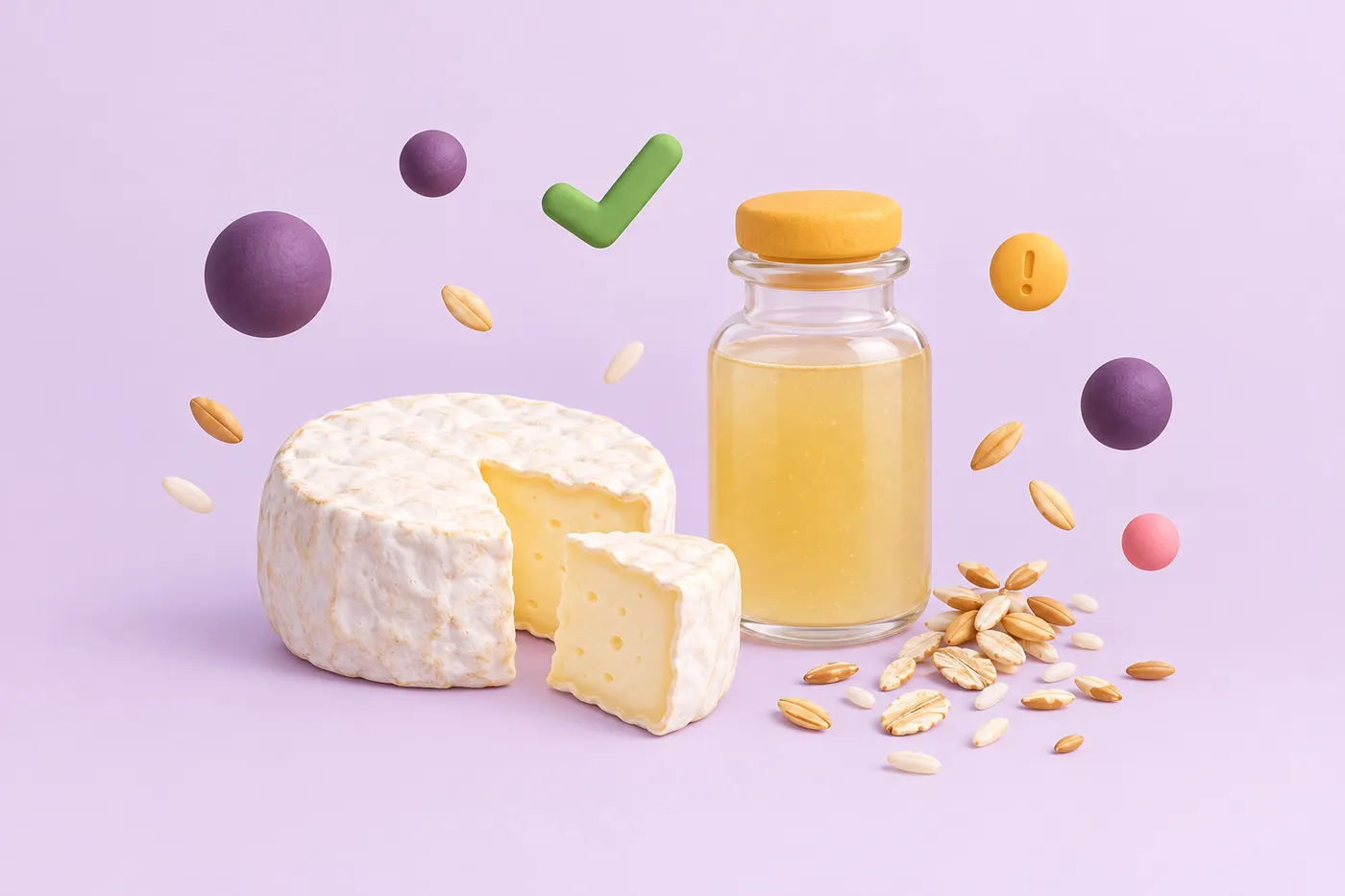
Starter cultures are not harvested from the wild in useful quantities. Manufacturers grow a chosen strain at industrial scale in a nutrient broth, and a 2025 review of adapting bacterial starters from dairy to plant substrates makes the underlying problem explicit: the traits that let a strain ferment milk, like breaking down casein and using lactose, do not automatically carry over to a plant-based substrate.[3] A strain bred for one medium is, to a real degree, a product of that medium.
A 2019 review of cultivation media for lactic acid bacteria in dairy products lays out the standard ingredients that go into dairy-industry growth broths, and it is blunt about the state of the science: despite the number of media developed for this purpose, results have been inconsistent, and the field still lacks a single reliable standard medium.[4] That is a research gap worth knowing about on its own terms. It also means there is no one dairy recipe to check against, only a range of dairy-based approaches in actual use.
By the time a culture reaches a factory, much of that history has been washed away. A food microbiology review of cereal-based fermentation notes that twentieth-century industrial microbiology replaced older, traditional culture propagation with pure, frozen or freeze-dried cultures grown on microbial media, especially in the dairy sector.[5] Freezing and freeze-drying strip out most of the liquid medium the organism grew in. What they do not do is tell you, after the fact, whether that medium contained milk.
The real fork in the road isn’t the bug, it’s the broth. The microorganism is never the animal-derived part. The question is what it was raised on, and that detail almost never survives onto the ingredient list.
Why non-dairy growth media exist
Dairy is not the only thing lactic acid bacteria will grow on, and manufacturers have real reasons to look elsewhere. A 2022 study of non-dairy fermented beverages states plainly that the non-dairy probiotics sector keeps expanding because of a rising number of vegan consumers and people who cannot tolerate dairy.[6] That is a market statement as much as a scientific one, but it tells you the dairy-free option is not hypothetical.
151 lactic acid bacteria strains tested on pea, chickpea, mung bean, fava bean and soy protein in one screen PMID 35407092
The science backs it up. A 2022 screen tested 151 lactic acid bacteria strains, drawn from both dairy and non-dairy origins, across pea, chickpea, mung bean, fava bean and soybean protein substrates.[7] The bacteria grew and fermented on all five plant proteins, though which strain performed best, in terms of acidification speed and flavor-enzyme activity, depended heavily on the substrate.[7] Dairy-free cultivation is not a lab curiosity. It is demonstrated, strain by strain, in the published record.
What that research does not tell you is which growth medium any specific jar of yogurt starter or packet of cheese culture used. A plant-based cheese using a non-dairy-grown culture and a plant-based cheese using a dairy-grown one can sit on the same shelf, look identical, and answer this question differently.
Rennet is a different question, and the one most shoppers mean
A lot of “is this vegan” confusion about cheese is really a rennet question wearing a starter culture costume. Rennet and starter cultures do two separate jobs. Dairy science defines rennet coagulation time as the measured interval between adding the rennet enzyme to milk and the start of coagulation, which is a precise way of saying rennet’s entire function is curdling the milk.[8] A starter culture’s job, covered above, is acidifying the milk and building flavor. They can each raise a separate vegan question about the same wheel of cheese.
Biotechnology has mostly resolved the rennet half of that question on its own. Cheesemakers once relied on rennet extracted from calf stomachs. A review of major technological advances in cheesemaking credits advances in microbial genetics with widespread use of fermentation-produced chymosin instead.[9] For cream cheese, the dairy base usually does the disqualifying work by itself, with rennet almost beside the point, and the same split holds for aged cheeses that use a starter culture on top of fermentation-produced rennet.
A cheese can clear the rennet question entirely, using lab-grown chymosin with no calf involvement, and still leave its starter culture’s growth medium completely unresolved. These are two checks, not one, and clearing one tells you nothing about the other.
What the evidence does, and doesn’t, settle
Here is where this article has to be honest about a limit. Whether a named certification body, such as a vegan trademark scheme, formally treats a starter culture’s growth medium as a processing aid that must itself be dairy-free is a trade-standards question that sits outside peer-reviewed food science, and no source in this article’s citation list addresses it. That is not a small caveat. It is the exact fact a strict vegan shopper would want and the literature search for this article could not produce it.
What the published research does establish, reliably, is the shape of the industry: both dairy-based and non-dairy growth media are genuinely in commercial use for lactic acid bacteria starter cultures.[4][6][7] What it does not establish is which medium underlies any single branded product on a shelf. That gap is not a failure of this research, it is a disclosure gap in the industry it studied.
Bottom line: the microorganism in a starter culture is never the animal-derived part. The growth medium sometimes is, and manufacturers are not required to say which.
How to check a label
Reading the ingredient panel for the words “bacterial culture” or “mold culture” will not answer the vegan question, because the growth medium almost never appears on the pack. A few checks do more work than squinting at the ingredient list:
- A certified vegan logo from a recognized body is the most reliable single signal, since it implies someone checked the production chain all the way back, past the finished recipe.
- A direct statement from the manufacturer about how its starter culture was grown is the next best thing, and some brands will provide it on request even when it is not printed.
- Plant-based packaging is not proof. A cashew-based camembert-style cheese can still use a culture grown on a dairy medium, the same way a dairy cheese can use a culture grown without one.
- For most people who eat dairy but avoid only animal-derived rennet, the starter culture’s growth medium is not the detail to worry about. Any trace dairy protein carried over from the medium is negligible once the culture is harvested and concentrated for sale.
If you want to scan a label for the additives that do show up in writing, from stabilizing gums to the additives in vegetable oil that can quietly make it non-vegan, the EatMatrix app reads the full ingredient panel, no barcode required, and flags what is worth a second look.
The honest verdict is a narrow one. The bacteria and molds in a starter culture are not animal products, and nearly every starter culture clears a simple kingdom-of-life test. What they were grown on before harvest is sometimes dairy, sometimes not, and the industry has no obligation to tell you which. A vegan logo or a direct answer from the manufacturer is the only way to close that gap, not a guess based on what the finished cheese looks like.
This article summarises publicly available regulatory assessments and peer-reviewed research about food ingredients. It is general information and is not intended to diagnose, treat, cure, or prevent any disease, and it is not personalised dietary or medical advice. Regulatory positions change; the EatMatrix app reflects the current assessments in our database. If you have an allergy, a medical condition, or are pregnant, talk to a qualified clinician or dietitian before changing what you eat.
References
- Use of Starter Cultures in Foods from Animal Origin to Improve Their Safety.. International journal of environmental research and public health, 2021.
- Nutritional and microbial profiles of ripened plant-based cheese analogs collected from the European market.. Food research international (Ottawa, Ont.), 2024.
- Adaptation of bacterial starter cultures from dairy to plant-based substrates: challenges and opportunities.. International journal of food microbiology, 2025.
- Cultivation media for lactic acid bacteria used in dairy products.. The Journal of dairy research, 2019.
- Starter cultures for cereal based foods.. Food microbiology, 2014.
- Non-Dairy Fermented Beverages Produced with Functional Lactic Acid Bacteria.. Microorganisms, 2022.
- Metabolic Conversions by Lactic Acid Bacteria during Plant Protein Fermentations.. Foods (Basel, Switzerland), 2022.
- Pathway-based genome-wide association analysis of milk coagulation properties, curd firmness, cheese yield, and curd nutrient recovery in dairy cattle.. Journal of dairy science, 2017.
- Major technological advances and trends in cheese.. Journal of dairy science, 2006.
Frequently asked questions
Are starter cultures vegan?⌄
The microorganisms themselves, usually bacteria, yeasts or molds, are not animal derived. Whether a specific starter culture is fully vegan depends on the growth medium it was raised in, which has historically been dairy based and is rarely disclosed on the label.
Is rennet the same thing as a starter culture?⌄
No. Rennet is an enzyme that coagulates milk to set a cheese's curd, while a starter culture is the microorganism that acidifies the milk and builds flavor. A cheese can clear the rennet question with fermentation produced chymosin and still leave its starter culture's growth medium unresolved.
Is fermentation produced chymosin vegan friendly?⌄
Fermentation produced chymosin is made by microorganisms through advances in microbial genetics rather than extracted from calf stomachs, and it is now the widely used form of rennet in commercial cheesemaking.
How can I tell if a starter culture was grown on a dairy medium?⌄
Reading the ingredient list for bacterial culture or mold culture will not tell you, since the growth medium almost never appears on the pack. A certified vegan logo from a recognized body or a direct statement from the manufacturer are the only reliable signals.
Does a plant based cheese always use a dairy free starter culture?⌄
Not necessarily. A plant based cheese using a non dairy grown culture and one using a dairy grown culture can look identical on the shelf, since plant based packaging alone is not proof of how the starter culture was grown.
More like this, by email
A weekly email with our new research-backed guides. No spam, unsubscribe any time.


