Is Cream Cheese Vegan? No, and Here's What's In the Tub
· 6 min read
Written and fact checked by EatMatrix Research Team
Food-additive research team at MAXHUMAN, MB, makers of the EatMatrix scanner
Every claim links to a primary source. Regulatory positions cite EFSA, FDA and WHO/JECFA opinions current at publication.
TL;DR
Cream cheese is not vegan. It is made primarily from pasteurized milk and cream, which settles the question before any additive comes into it. The two things actually worth checking a label for are gelatin, an animal-derived stabilizer used in some reduced-fat and whipped tubs, and E471, an emulsifier that can be plant or animal sourced without the label saying which.
Key takeaways
- Cream cheese fails a vegan standard from the dairy base alone, not from any additive
- Locust bean gum, guar gum and xanthan gum are plant or microbial, never an animal-derived concern
- Gelatin (E428) in some reduced-fat and whipped tubs is the real accidental non-vegan risk
- E471's plant or animal source is not required to appear on the label
- Coconut-oil-based plant alternatives run higher in saturated fat than cashew or tofu based versions
Understand the ingredients on your next food label.
Use EatMatrix on your iPhone to scan an ingredient list and explore the ingredient information in the app. Start with a label you already have.
Get EatMatrix for iPhoneOn this page
- What’s in a tub of cream cheese
- The gums in the ingredient list, and where they come from
- Gelatin: the one addition that makes a tub non-vegan for a second reason
- Mono- and diglycerides: the ingredient whose source isn’t on the label
- What plant-based cream cheese alternatives are made from
- How to check a tub yourself, instead of guessing from the category
- References
Cream cheese is not vegan, and the reason has nothing to do with anything on the ingredient list below the first line. It is made from pasteurized milk and cream, and that settles the question before you ever get to a stabilizer or a gum. What matters more for a label-reader is a different fact: two unrelated additives, gelatin and E471, can make one specific tub non-vegan (or not) for reasons that have nothing to do with dairy, and checking for them is the part people skip.
What’s in a tub of cream cheese
Cream cheese is a fresh, unripened dairy cheese. Food-composition standards require it to be made primarily from pasteurized milk and cream, with a minimum milkfat content, which is why “cream cheese” is a defined category rather than a marketing name a brand can apply loosely.
Food science conventionally describes cream cheese’s curd as set by acid-producing starter cultures rather than the rennet enzymes used in aged cheeses like cheddar. That distinction is standard in dairy science texts, but the literature search behind this article did not turn up a study that pins down cream cheese’s coagulation method specifically, so treat it as trade knowledge rather than a cited finding.
Either way, the vegan verdict does not hinge on it. Cream cheese is built from milk and cream, and it fails a vegan standard for the same reason milk itself does, not because of an enzyme added somewhere in production.
The gums in the ingredient list, and where they come from
Most commercial tubs list one or more gum stabilizers, and these are the ingredients that make shoppers nervous. Locust bean gum (E410), guar gum (E412) and xanthan gum (E415) belong to a family of hydrocolloids added to dairy products such as cheeses to keep a creamy texture and stop the watery separation (syneresis) that otherwise happens in a tub left on a shelf.[1]
Where these three come from:
- Guar gum is extracted from guar bean seeds, a seed-flour gum in the same category as locust bean gum.
- Locust bean gum comes from carob tree seeds, the same pods used to make a cocoa-free chocolate substitute.
- Xanthan gum comes from bacterial fermentation of sugars, a different process entirely from the seed extraction behind the other two.
Food science classifies all three this way, as seed-flour gums or a fermentation product, placing them in categories distinct from the animal-derived gums used elsewhere in food, such as gelatin or isinglass.[2] None of them raise a vegan question. The guar gum that keeps a tub spreadable is the same gum used to firm up gluten-free bread dough and keep ice cream from forming large ice crystals.
Bottom line on the gums: none of the common cream cheese stabilizers are animal-derived. If a tub is non-vegan, it is not because of E410, E412 or E415.
EFSA’s safety re-evaluations of these gums focus on intake levels. Animal content was never the question EFSA needed to settle, since the additives were already plant or microbial before anyone raised a safety concern.
Gelatin: the one addition that makes a tub non-vegan for a second reason
This is the ingredient worth checking for. Gelatin (E428) is a protein produced mostly from pig skin and cattle hides and bones, used across the food industry as a stabilizer, gelling agent and thickener.[3] It is the same protein that gives gummy candy its chew and marshmallows their stretch, pulled from a different part of the same animal supply chain.
Some reduced-fat and whipped cream cheese formulations use gelatin to hold air and water in place once fat is removed. If it shows up on the ingredient panel, that tub is non-vegan for an additional, separate reason beyond the dairy base itself. The front of the package will not tell you. Reading the ingredient list is the only way to catch it, since gelatin’s presence does not track with “light”, “whipped” or “original” labeling in any reliable way.
Mono- and diglycerides: the ingredient whose source isn’t on the label
Monoglycerides and diglycerides of fatty acids (E471) show up in some cream cheese spreads as an emulsifier, and they are genuinely hard to pin down from the label alone. They can be manufactured from either plant oils or animal fat, and current food labeling rules do not require a brand to disclose which one was used in a given product.
That is not a rare or unusual additive. Mono- and diglycerides of fatty acids are among the most widely consumed food additives in the modern diet, found in the diets of 78.1 percent of adults in a large French cohort study.[4]
78.1% of French adults consume mono- and diglycerides of fatty acids (E471) PMID 34608173
Because E471’s source is undisclosed on pack, a strict vegan cannot resolve its origin from the ingredient list alone. The only paths are a manufacturer’s separate vegan claim, a certification mark, or contacting the brand directly, the same workaround needed for other dual-sourced additives covered in our guide to food additives worth watching for a real reason.
What plant-based cream cheese alternatives are made from
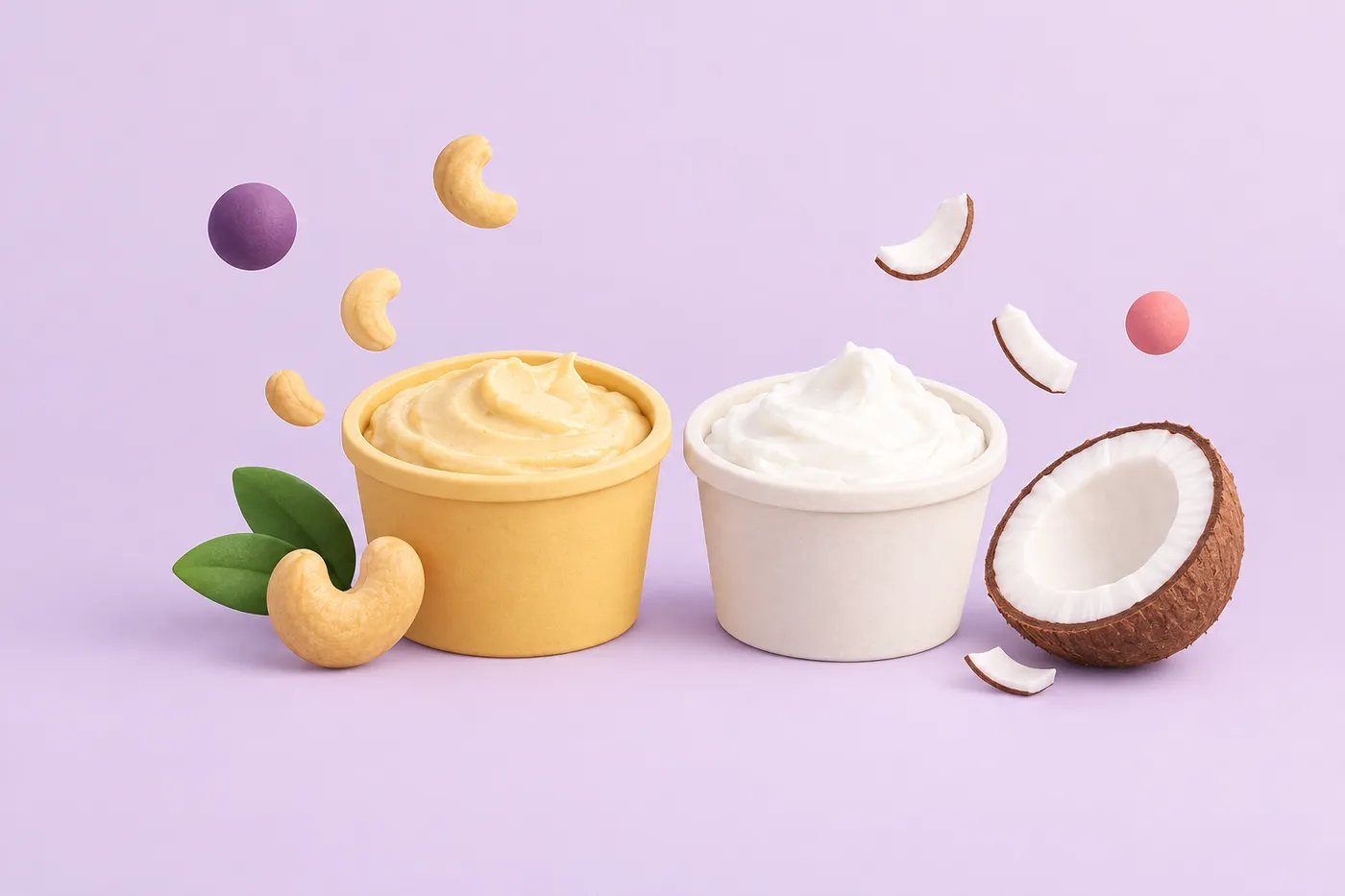
The vegan versions on the shelf next to the dairy tubs are not simply “cream cheese minus the dairy.” They are a different food built from a different base, most often coconut oil, cashew nuts or tofu, with hydrocolloid gum stabilizers added to get anywhere close to dairy’s spreadability and mouthfeel.[5]
An audit of plant-based cheese products sold in Spanish supermarkets found a clear split by base ingredient, and it is not an even split:[6]
Plant-based cheese alternatives audited, by base ingredient
Coconut oil is the dominant base by a wide margin.
The coconut-oil-based products, the overwhelming majority of what is on shelves, ran high in saturated fat and salt. The smaller cashew nut and tofu groups showed a healthier nutritional profile by comparison.[6] “Plant-based” and “lower in saturated fat” are not the same claim, in the same way an ultra-processed label on oat milk tells you less than it sounds like it does.
There is also an allergy wrinkle worth knowing before assuming a swap is automatically the safer move. Immune-reactivity testing found some people who show no reaction to dairy milk still test positive for IgE or IgG reactivity to coconut, almond or soy milk substitutes, which means switching to a plant-based substitute should not be assumed to be automatically free of allergenic risk, only a different one.[7]
How to check a tub yourself, instead of guessing from the category
The category alone does not answer the question. Confirming any specific tub is vegan means reading the ingredient panel for:
- Milk, cream or whey, the dairy base itself.
- Casein, a milk protein sometimes added separately as a stabilizer.
- Gelatin, the animal-derived stabilizer covered above.
Front-of-pack wording like “natural” or “farmhouse style” carries no regulated meaning related to animal content. A certified vegan logo is different: it requires actual ingredient verification from the certifying body, which is why it is worth more than a marketing adjective.
The actual check: dairy cream cheese is out automatically. A plant-based tub needs its own label check for gelatin and, where the source matters to you, for E471.
If you are standing in the aisle and do not want to parse an E-number from memory, that is the specific job a label scanner like the EatMatrix app is built for: point it at the panel and it reads the additives for you instead of asking you to recognize E428 on sight.
Get the app on the App Store.
This article summarises publicly available regulatory assessments and peer-reviewed research about food ingredients. It is general information and is not intended to diagnose, treat, cure, or prevent any disease, and it is not personalised dietary or medical advice. Regulatory positions change; the EatMatrix app reflects the current assessments in our database. If you have an allergy, a medical condition, or are pregnant, talk to a qualified clinician or dietitian before changing what you eat.
References
- An Updated Review on Exploring Hydrocolloids Application in Food Matrix: Current Insights Into Fruit, Bakery, Meat, and Dairy Based Products.. Journal of texture studies, 2025.
- Application of guar (<i>Cyamopsis tetragonoloba</i> L.) gum in food technologies: A review of properties and mechanisms of action.. Food science & nutrition, 2023.
- Fish gelatin.. Advances in food and nutrition research, 2010.
- Exposure to food additive mixtures in 106,000 French adults from the NutriNet-Santé cohort.. Scientific reports, 2021.
- Fermentation-A Potential Game Changer in the Development of Plant-Based Cream Cheese Alternatives.. Foods (Basel, Switzerland), 2026.
- Nutritional Quality of Plant-Based Cheese Available in Spanish Supermarkets: How Do They Compare to Dairy Cheese?. Nutrients, 2021.
- Immune reactivity against a variety of mammalian milks and plant-based milk substitutes.. The Journal of dairy research, 2018.
Frequently asked questions
Is cream cheese vegan?⌄
No. Cream cheese is made primarily from pasteurized milk and cream, so it fails a vegan standard the same way milk itself does, regardless of what else is on the ingredient list.
Does cream cheese contain rennet?⌄
Food science conventionally describes cream cheese's curd as set by acid-producing starter cultures rather than rennet, unlike aged cheeses such as cheddar, though this article did not find a study that verifies this for cream cheese specifically.
Is there gelatin in cream cheese?⌄
Some reduced-fat and whipped cream cheese formulations add gelatin (E428), an animal-derived protein stabilizer, so checking the ingredient panel for it is the only reliable way to know if a specific tub contains it.
Is E471 vegan?⌄
It depends on the tub. Monoglycerides and diglycerides of fatty acids (E471) can be manufactured from plant oils or animal fat, and labeling rules do not require a brand to disclose which one was used.
Is plant-based cream cheese healthier than dairy cream cheese?⌄
Not automatically. An audit of plant-based cheese in Spanish supermarkets found coconut-oil-based versions, the majority of the category, ran high in saturated fat and salt, while cashew nut and tofu based versions showed a healthier profile.
More like this, by email
A weekly email with our new research-backed guides. No spam, unsubscribe any time.