Palm Oil's Health Risk Comes Down to One Fatty Acid
· 7 min read
Written and fact checked by EatMatrix Research Team
Food-additive research team at MAXHUMAN, MB, makers of the EatMatrix scanner
Every claim links to a primary source. Regulatory positions cite EFSA, FDA and WHO/JECFA opinions current at publication.
TL;DR
Palm oil raises LDL cholesterol because of palmitic acid, its dominant fatty acid, more than canola or soybean oil but less than butter. The bigger population studies that track diets over years have not found a clear link between saturated fat and heart disease, which is a real but unsettled puzzle, not proof that palm oil is harmless.
Key takeaways
- Palm oil's LDL effect comes from palmitic acid, confirmed in a controlled feeding trial
- Trials put palm oil's LDL effect between unsaturated oils and butter, not at either extreme
- A 2015 cohort meta-analysis found no significant link between saturated fat and heart disease
- The same data found industrial trans fats, which palm oil replaced, linked to higher heart disease risk
- Red palm oil is a different, unrefined product with a documented vitamin A benefit
Understand the ingredients on your next food label.
Use EatMatrix on your iPhone to scan an ingredient list and explore the ingredient information in the app. Start with a label you already have.
Get EatMatrix for iPhoneOn this page
Palm oil raises LDL cholesterol, and the reason is one fatty acid: palmitic acid, which dominates its fat content and is the component controlled trials link to higher LDL.[1] That effect is real and measurable, but it sits in the middle of the pack: smaller than swapping in butter, bigger than swapping in canola or soybean oil. The thing people get wrong is treating the big population studies on diet and heart disease as proof that palm oil itself causes heart attacks. The largest pooled analysis of that kind of evidence found no significant link between saturated fat intake and heart disease at all, which is a genuinely strange result once you have just read about palm oil’s LDL effect in a trial.
Palm oil’s LDL effect traces to one fatty acid
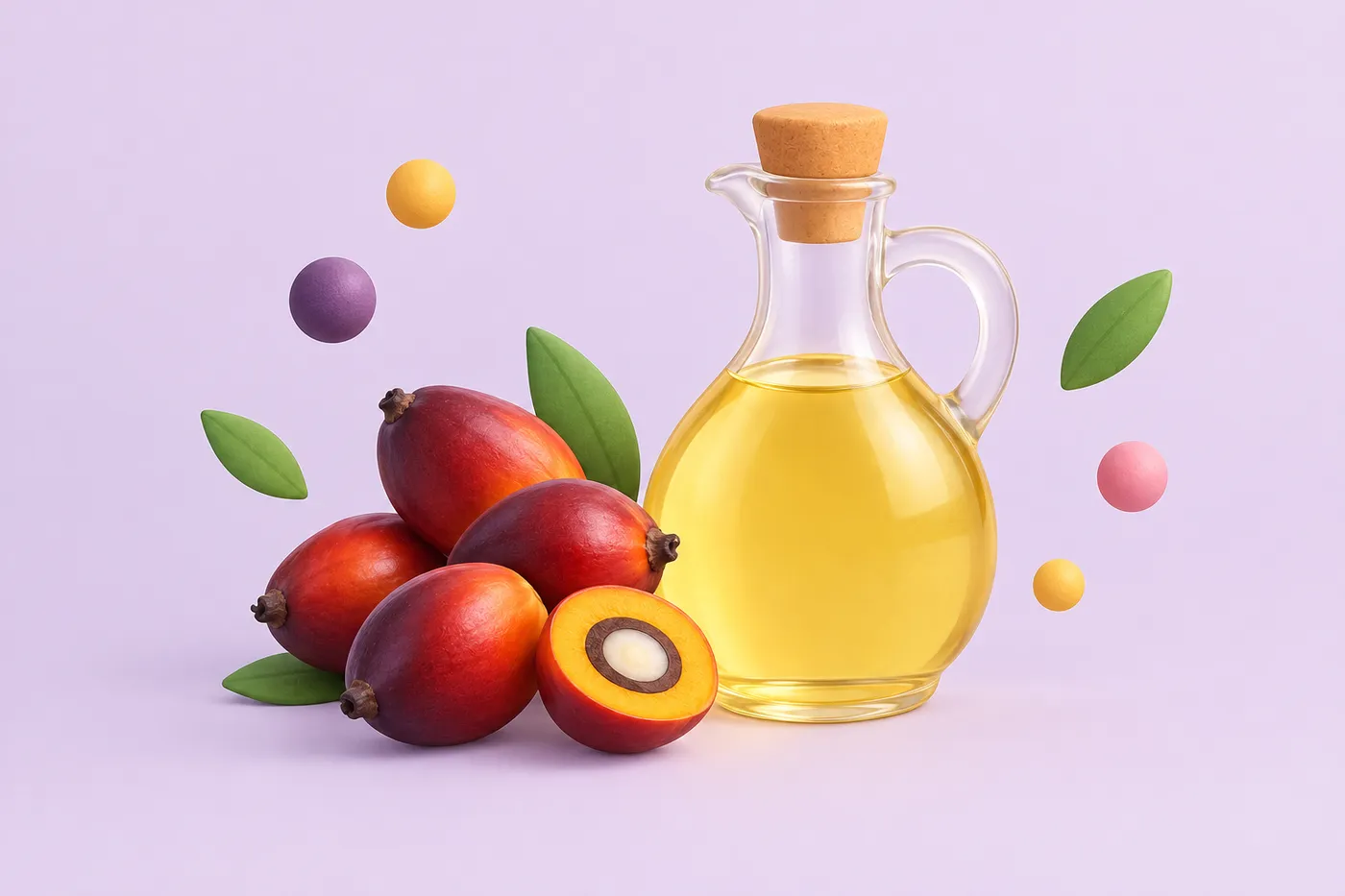
Palm oil is not uniformly “bad fat.” Its problem is concentrated in palmitic acid, the saturated fatty acid that makes up most of its fat content.
A controlled feeding trial that put adults on diets matched for calories but differing in fatty acid content found LDL cholesterol ran about 0.50 mmol/L higher on a high palmitic acid diet than on a high oleic acid diet (the fatty acid that dominates olive oil and high oleic sunflower oil).[1] That is a direct mechanistic link: swap the fatty acid, and the cholesterol marker moves with it.
This matters because it tells you what to compare palm oil against. The relevant question is not “is palm oil dangerous” in the abstract. It is “how does palm oil’s palmitic acid content compare to whatever it is replacing on the shelf.”
What the randomized trials found
The clearest evidence on palm oil comes from feeding trials: studies that put real people on controlled diets and measure blood lipids before and after.
- Versus unsaturated vegetable oils: a meta-analysis of clinical trials found palm oil raised LDL cholesterol by 0.31 mmol/L more than vegetable oils low in saturated fat, in the subset of trials that were randomized.[2]
- Versus olive and canola oil specifically: a systematic review and meta-analysis of 51 intervention trials found palm oil diets produced significantly higher LDL cholesterol than diets rich in monounsaturated or polyunsaturated fat, the categories that cover olive, canola and sunflower oil.[3]
- Versus butter: a network meta-analysis of 54 randomized trials found palm oil, grouped with safflower, sunflower, rapeseed, olive and soybean oil, still lowered LDL cholesterol by 0.23 to 0.42 mmol/L compared with butter.[4]
Bottom line: palm oil raises LDL more than the oils in your salad dressing aisle, and less than butter does. It is not the best fat on the shelf, and it is not the worst either.
Here is the limit on all three findings. The trials behind them ran for 2 to 16 weeks and measured cholesterol markers rather than heart attacks or strokes.[3] Watching a risk marker move for a few weeks is useful information, but it is a different kind of evidence than watching a disease happen over years.
Where palm oil ranks against other fats on LDL cholesterol
| Swapped in for palm oil | Effect on LDL cholesterol | Evidence |
|---|---|---|
| Soybean oil | About 12% lower LDL than palm oil | Controlled feeding trial, 15 adults with elevated LDL[5] |
| Canola oil | About 16% lower LDL than palm oil | Same controlled feeding trial[5] |
| Vegetable oils low in saturated fat (general) | Palm oil raised LDL 0.31 mmol/L more | Meta-analysis of randomized trials[2] |
| Butter (reverse direction) | Palm oil was 0.23 to 0.42 mmol/L lower in LDL than butter | Network meta-analysis, 54 trials[4] |
Each row is a different comparison oil rather than one ranking scale.
Why the population studies tell a different story
This is the part that trips people up. If palm oil (and saturated fat generally) raises a cholesterol marker that predicts heart disease, shouldn’t the big studies that track what people eat over years show palm oil eaters having more heart attacks?
They do not, at least not clearly. A 2015 systematic review and meta-analysis pooled prospective cohort studies covering up to 339,090 people and found saturated fat intake, the category that includes palm oil, was not associated with coronary heart disease, stroke or all-cause mortality.[6] The authors rated the certainty of that finding as very low, because diet studies that follow people for years are full of confounding: someone eating more saturated fat is also eating differently in a dozen other ways that get tangled up in the result.
That is the actual distinction worth holding onto:
- Randomized trials assign people to a specific fat and hold other variables constant. They can isolate palm oil’s own effect on a measurable marker like LDL cholesterol.
- Cohort studies watch what people already eat and tally outcomes years later. They are better at catching rare, long-term, real-world effects, but they cannot rule out that something else about a high-palm-oil diet is doing the damage instead of the palm oil itself (or, here, failing to do any damage at all).
No study design available answers “does palm oil cause heart attacks in humans” directly. The trial evidence establishes a cholesterol marker effect. The cohort evidence does not establish a clinical event effect either way, at least not with any confidence.
The same 2015 analysis is also where the trans fat comparison gets interesting. Industrial trans fats, unlike the trans fats naturally present in dairy and meat, were associated with higher coronary heart disease mortality (relative risk 1.18) and higher coronary heart disease incidence (relative risk 1.42) in that same pooled cohort data.[6] Palm oil is solid at room temperature without needing hydrogenation, which is exactly why food manufacturers reached for it as the replacement for those industrially produced trans fats.
1.42 relative risk of coronary heart disease linked to industrial trans fats, the fat palm oil largely replaced PMID 26268692
A fat with a measurable but moderate LDL effect, swapped in for a fat with a clearer link to heart disease in the same data, is not the villain-swap story the “seed oil” and “palm oil is poison” corners of the internet tell. It is closer to a lateral move with a real but smaller cost.
How much palm oil the trials tested
None of this is a dosing guide, because none of these trials were designed to tell you how much palm oil to eat. They were designed to isolate its effect.
Across the 51 trials in the largest meta-analysis, the fat substitution tested ranged from 4% to 43% of daily energy intake, over periods of 2 to 16 weeks.[3] That is a share of total calories rather than a fixed gram target, and it is a wider range than most “how much is safe” headlines imply.
Palm oil’s real-world exposure is also wider than a home cook choosing a cooking oil. It is the world’s most widely produced vegetable oil, and its dominance in the food processing industry means it shows up across the packaged food supply, not just in whatever bottle sits on your counter.[7] Reading the ingredient panel on a box of crackers is usually the only way to know it is there at all, which is the entire reason a label scanner is useful for this ingredient specifically.
Red palm oil is a different product, and it has a real upside
Most palm oil in packaged food is refined and colorless. Red palm oil is a different, unrefined product, and it is worth separating from the rest of this article because its profile is genuinely different.
Red, unrefined palm olein carries more total tocopherols and tocotrienols than the more refined yellow palm olein used in most packaged food (1260 parts per million versus 940 in one analysis), along with carotenes that deplete further during processing like frying.[8] Those carotenes are the same compounds that give red palm oil its color and its provitamin A content.
That provitamin A content is where red palm oil’s best human evidence sits. A meta-analysis of nine randomized controlled trials found red palm oil supplementation reduced the relative risk of vitamin A deficiency to 0.55 and raised serum retinol and beta-carotene levels, with no significant effect on body weight or hemoglobin.[9]
0.55 relative risk of vitamin A deficiency with red palm oil supplementation, in a meta-analysis of 9 randomized trials PMID 29186779
That is a real, sourced benefit, and it does not cancel out the saturated fat and palmitic acid content discussed above. Vitamin A status and LDL cholesterol are two separate outcomes. A product can genuinely help with one and still carry the same fatty acid profile driving the other.
Where this leaves a shopper reading a label
Palm oil is not the cooking oil to reach for first if LDL cholesterol is your main concern. It also doesn’t deserve the alarm-driven framing it gets in some corners of social media.
What the evidence supports, in order of confidence:
- Swap it for olive, canola or soybean oil if you can, for a modest LDL benefit. The effect size is real but not dramatic, somewhere around 12 to 16% lower LDL in a direct controlled comparison.[5]
- Don’t worry that palm oil is secretly as bad as butter. The randomized trial evidence puts it closer to the middle, clearly better than butter on LDL, clearly worse than the main vegetable oils.[4][3]
- Don’t extrapolate the cohort null result into “saturated fat is totally fine.” The cohort data not finding a significant association is a real finding, but the authors themselves called the certainty very low, and it sits alongside a cleaner trial-based LDL effect that is hard to explain away.[6]
- If you specifically see “red palm oil” rather than “palm oil,” that’s a different product with a documented vitamin A benefit in populations at risk of deficiency, which is a narrower claim than a general cardiovascular recommendation.[9]
The honest summary is that palm oil’s health story is a moderate, well-documented LDL effect from one fatty acid, sitting inside a much noisier debate about saturated fat and heart disease that the best available evidence has not settled either way. That is less dramatic than “palm oil is poison,” and more useful.
If you want to see how palm oil compares to the oil named on your label, canola oil is one of the unsaturated options the trials above measured directly against it. Scanning the label is the fastest way to find out which one you are eating, and that is the exact problem the EatMatrix app is built to solve.
This article summarises publicly available regulatory assessments and peer-reviewed research about food ingredients. It is general information and is not intended to diagnose, treat, cure, or prevent any disease, and it is not personalised dietary or medical advice. Regulatory positions change; the EatMatrix app reflects the current assessments in our database. If you have an allergy, a medical condition, or are pregnant, talk to a qualified clinician or dietitian before changing what you eat.
References
- Impact of myristic acid versus palmitic acid on serum lipid and lipoprotein levels in healthy women and men.. Arteriosclerosis and thrombosis : a journal of vascular biology, 1994.
- Palm Oil Consumption Increases LDL Cholesterol Compared with Vegetable Oils Low in Saturated Fat in a Meta-Analysis of Clinical Trials.. The Journal of nutrition, 2015.
- Palm oil and blood lipid-related markers of cardiovascular disease: a systematic review and meta-analysis of dietary intervention trials.. The American journal of clinical nutrition, 2014.
- Effects of oils and solid fats on blood lipids: a systematic review and network meta-analysis.. Journal of lipid research, 2018.
- Palm and partially hydrogenated soybean oils adversely alter lipoprotein profiles compared with soybean and canola oils in moderately hyperlipidemic subjects.. The American journal of clinical nutrition, 2006.
- Intake of saturated and trans unsaturated fatty acids and risk of all cause mortality, cardiovascular disease, and type 2 diabetes: systematic review and meta-analysis of observational studies.. BMJ (Clinical research ed.), 2015.
- The palm oil industry and noncommunicable diseases.. Bulletin of the World Health Organization, 2019.
- Molecular mechanism of antioxidant synergism of tocotrienols and carotenoids in palm oil.. Journal of agricultural and food chemistry, 2006.
- The Effect of Red Palm Oil on Vitamin A Deficiency: A Meta-Analysis of Randomized Controlled Trials.. Nutrients, 2017.
Frequently asked questions
Is palm oil bad for you?⌄
Palm oil raises LDL cholesterol more than unsaturated oils like canola or soybean oil, but less than butter, according to controlled feeding trials. Large cohort studies have not found a significant link between saturated fat intake and heart disease, so the evidence is real but moderate rather than alarming.
Is palm oil worse than butter?⌄
No. A network meta-analysis of 54 randomized trials found palm oil still lowered LDL cholesterol by 0.23 to 0.42 mmol/L compared with butter.
What is the difference between palm oil and red palm oil?⌄
Most palm oil in packaged food is refined and colorless. Red, unrefined palm oil carries more tocopherols, tocotrienols and carotenes, and a meta-analysis of nine randomized trials found it reduces the relative risk of vitamin A deficiency.
Should I switch from palm oil to olive or canola oil?⌄
A controlled feeding trial found replacing palm oil with soybean oil lowered LDL cholesterol by about 12%, and canola oil lowered it by about 16%, so switching gives a modest, real benefit if LDL cholesterol is your main concern.
Does palm oil cause heart attacks?⌄
No study has established that directly. The randomized trials measure cholesterol markers over 2 to 16 weeks, not heart attacks or strokes, and the largest cohort analysis found no significant association between saturated fat intake and coronary heart disease.
More like this, by email
A weekly email with our new research-backed guides. No spam, unsubscribe any time.