Foods With Vitamin D Won't Fix a Deficiency on Their Own
· 7 min read
Written and fact checked by EatMatrix Research Team
Food-additive research team at MAXHUMAN, MB, makers of the EatMatrix scanner
Every claim links to a primary source. Regulatory positions cite EFSA, FDA and WHO/JECFA opinions current at publication.
TL;DR
Only a short list of foods, fatty fish, dairy milk, eggs and fortified staples like plant milk and cereal, supply meaningful vitamin D, and national survey data show food alone usually falls short of the daily target for most women over 12 and men over 50. Sun exposure does most of the real work, so a blood test, not guesswork, is the way to know whether you actually need a supplement.
Key takeaways
- Fatty fish and dairy milk are the most-consumed vitamin D food sources in the largest recent US diet study
- The 600 IU recommended daily allowance is a floor, not a guarantee of sufficiency for everyone
- The VITAL trial found vitamin D supplementation did not lower cancer or heart disease risk in 25,871 adults
- Vitamin D absorption was 32 percent higher when a dose was taken with a fat-containing meal
- Toxicity comes from high-dose supplements, not food, and the safe upper limit is 4,000 IU a day
Understand the ingredients on your next food label.
Use EatMatrix on your iPhone to scan an ingredient list and explore the ingredient information in the app. Start with a label you already have.
Get EatMatrix for iPhoneOn this page
- The short list, and why it stays short
- The number everyone quotes, and what it leaves out
- Inside the nearly 26,000-person VITAL trial
- Where supplementation clearly helps: respiratory infections, if you’re deficient
- Why “vitamin D has been a game changer” for IBS isn’t a settled fact
- Fat makes the vitamin work harder
- How much is too much, and why it is almost never the salmon
- Sun does most of the job, food fills the gap
- What the trials still haven’t settled
- References
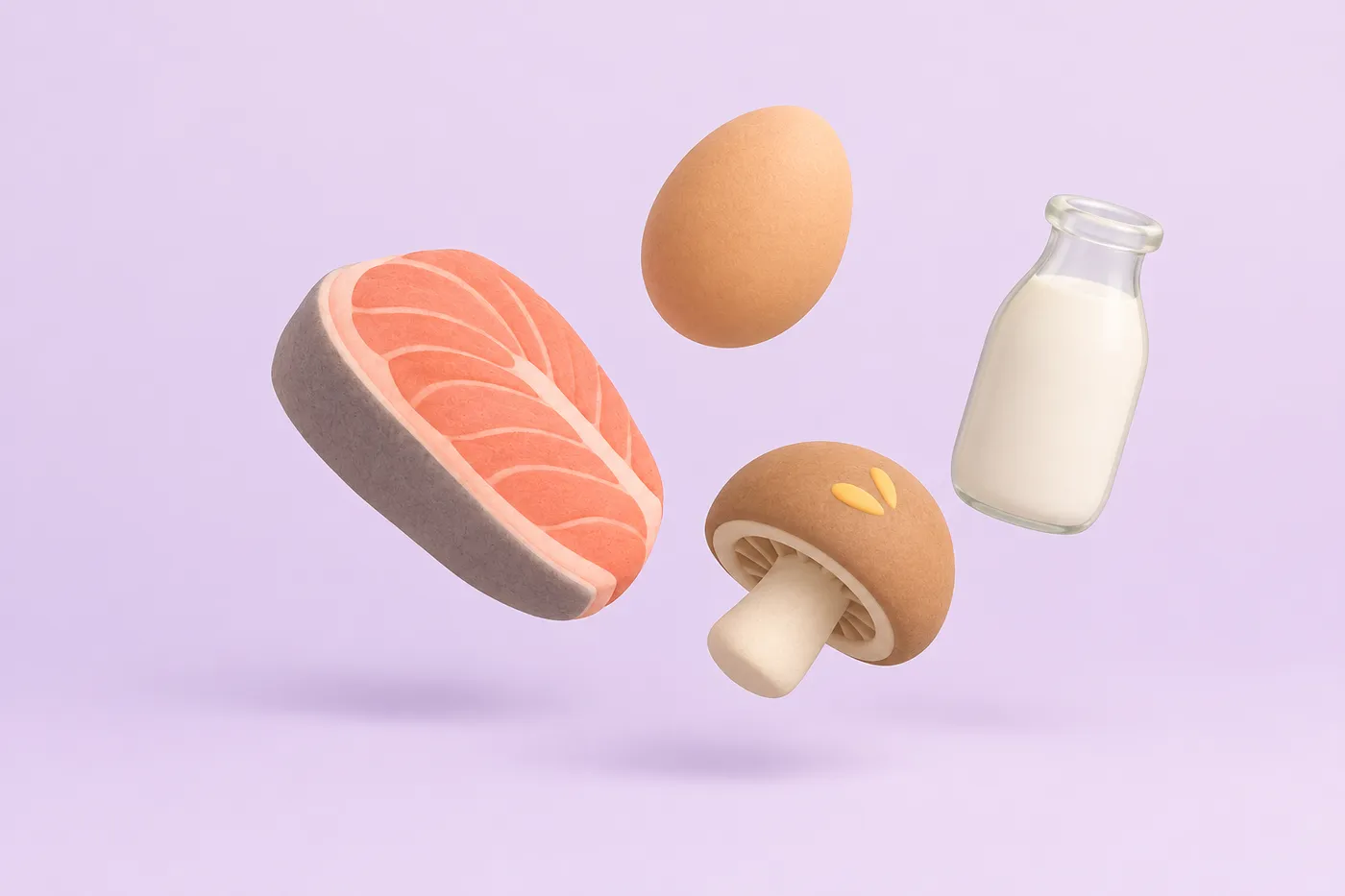
The list of foods that naturally carry meaningful vitamin D is short, and that is not a diet failing on your part. Fatty fish and dairy milk are the two food sources people eat enough of to matter, according to the largest recent US dietary analysis, with eggs, fortified plant milk, citrus juice, cereal, organ meats and cheese filling in behind them.[1]
For most people, food was never meant to carry the whole load. Sun exposure does most of the work, and supplements or fortified staples cover the rest. The question worth asking isn’t “which food has the most vitamin D,” it’s “does my combination of sun, food and supplements add up.”
The short list, and why it stays short
A 2025 cohort study followed more than 13,000 US Hispanic and Latino adults and tracked exactly what they ate over repeated dietary recalls.[1] Fish products and dairy milk were the most-consumed vitamin D sources in that group, ahead of eggs, plant-based milk alternatives, citrus juice, ready-to-eat cereals, organ meats, yogurt, margarine and cheese. Usual vitamin D intake from food alone averaged about 5 micrograms a day, whether or not someone also took a supplement.
That number matters because it sits well under most intake targets. Vitamin D is not evenly distributed across the food supply the way protein or fiber is. It concentrates in a handful of animal foods and whatever manufacturers choose to fortify, which is exactly why “eat more vitamin D foods” is harder advice to follow than it sounds.

The number everyone quotes, and what it leaves out
The current recommended dietary allowance for vitamin D is 600 IU a day. That is the benchmark a randomized trial in black and white children used as its own target, and the trial is worth knowing about because of what it found: even hitting 600 IU wasn’t enough to bring at least half of the children studied to the blood level needed for bone health.[2] That trial studied children, so it does not prove the adult figure is wrong. It does show that the RDA functions as a floor, never meant to be a ceiling that guarantees sufficiency for everyone.
National survey data back this up from the food side. NHANES III found that median vitamin D intake from food alone falls below the adequate intake level for most women over age 12 and most men over age 50 in the United States.[3] Natural food sources are limited, and the US largely depends on fortified milk and breakfast cereal to close the gap, the same review notes, a strategy that cross-sectional data suggest still leaves vulnerable groups short, especially in winter.
Bottom line: the RDA is a target built around “most people, most of the time.” It is not a guarantee, and the food supply on its own was never built to hit it reliably.
Inside the nearly 26,000-person VITAL trial
The best-powered human trial on vitamin D supplementation is the VITAL trial: 25,871 US adults, men 50 and older and women 55 and older, randomized to 2,000 IU of vitamin D3 a day or placebo for a median of 5.3 years.[4] Vitamin D did not lower the risk of invasive cancer (hazard ratio 0.96) or major cardiovascular events (hazard ratio 0.97) compared with placebo. Both results were statistically unremarkable, meaning the trial found no protective effect worth acting on for those two outcomes, in people who were not already deficient.
25,871 adults randomized in the VITAL trial, the largest vitamin D3 supplementation trial run to date PMID 30415629
That is an important correction to a common assumption: vitamin D is not a general-purpose disease-prevention pill. Where it does earn its keep is narrower, and the next finding shows exactly where.
Where supplementation clearly helps: respiratory infections, if you’re deficient
A meta-analysis of individual-level data from 25 randomized trials, covering 10,933 participants, found vitamin D supplementation reduced the overall risk of acute respiratory tract infection (odds ratio 0.88).[5] The effect held for people taking daily or weekly doses. Occasional large boluses did not show the same benefit, and the protection was far stronger in people who started severely deficient (odds ratio 0.30 for those under 25 nmol/L at baseline) than in people who were already closer to sufficient (odds ratio 0.75).
In plain terms: this isn’t a vitamin that helps everyone equally. It helps the people who were genuinely short on it, dosed consistently rather than in occasional megadoses.
Why “vitamin D has been a game changer” for IBS isn’t a settled fact
A common claim circulating in online gut-health communities is that vitamin D turned around someone’s irritable bowel syndrome. The research on this is genuinely split down the middle.
- A 2022 meta-analysis of 8 studies and 685 IBS patients found vitamin D supplementation significantly improved symptom severity scores compared with placebo.[6]
- A separate 2022 meta-analysis of 6 randomized trials and 616 patients found no significant difference between vitamin D and placebo on that same primary severity score, even though it did find a significant improvement in quality of life and in blood vitamin D levels.[7]
Both reviews are pulling from a small, overlapping pool of trials. That is exactly the situation where observational enthusiasm outruns what a controlled trial can prove.
- Observational studies can show that people with higher vitamin D have milder IBS, but they cannot rule out that the same people also eat better, move more, or get outside more.
- Only a randomized trial, assigning a fixed dose against a placebo, isolates whether raising vitamin D itself changes anything.
That is the honest state of the IBS evidence: promising in one analysis, null on the primary measure in another. Worth discussing with a clinician if you have IBS and low vitamin D. Not yet a “game changer” by the trial evidence itself.
Fat makes the vitamin work harder
Vitamin D is fat-soluble, and that is not a trivia fact, it changes how you should eat the foods that carry it. A randomized trial in 50 healthy older adults gave everyone a single 50,000 IU dose with either a fat-containing or a fat-free breakfast. Peak plasma vitamin D3 came in 32% higher in the fat-containing group.[8]
32% higher peak plasma vitamin D3 when a dose was taken with a fat-containing meal instead of a fat-free one PMID 25441954
This is the same logic that shows up whenever fat intake interacts with what your body absorbs, the kind of dose-dependent effect this site has covered for palm oil’s effect on LDL cholesterol and for canola oil’s fat profile. Fat is never just calories. It is a delivery vehicle for whatever else is riding along with it.
Whether whole foods that carry their own fat (egg yolks, fatty fish, whole milk) absorb vitamin D better than a fat-free fortified product has not actually been tested head to head in the published literature. That is a reasonable inference from the fat-absorption trial above. Treat it as a sensible habit rather than a proven shortcut.
How much is too much, and why it is almost never the salmon
The tolerable upper intake level for vitamin D is set at 4,000 IU a day for the general population. Even that range is not entirely free of friction: a meta-analysis of 22 trials and 12,952 participants testing daily doses of 3,200 to 4,000 IU found a small increased risk of hypercalcemia, falls and hospitalization.[9]
Dose and outcome across the trials
| Daily dose | What the trials found | Source |
|---|---|---|
| 800 to 1,000 IU | Lower fracture risk (RR 0.87) and fall risk (RR 0.91) across 32 randomized trials | pmid:35504603 |
| Below 800 IU or above 1,000 IU, or intermittent high doses | No significant reduction in falls or fractures in the same analysis | pmid:35504603 |
| 3,200 to 4,000 IU, long-term | Small increased risk of hypercalcemia, falls and hospitalization across 22 trials | pmid:36853379 |
Daily vitamin D3 dose and the outcomes reported at each range.
The one real downside: vitamin D toxicity is real, and it traces back to supplement bottles rather than dinner plates. A clinical review of vitamin D toxicity describes it as rare and caused by excessive long-term intake, producing hypercalcemia with confusion, vomiting and abdominal pain.[10] Case reports behind that same toxicity literature involve self-prescribed megadoses and multi-month overdosing, never a diet built around salmon and eggs.
You cannot eat your way into vitamin D toxicity. You can supplement your way into it, which is the actual reason to read a supplement label before stacking two or three vitamin D products at once.
Sun does most of the job, food fills the gap
Ultraviolet B light hitting the skin converts a cholesterol precursor into previtamin D3, and that pathway is what most humans have historically depended on for their vitamin D, more than diet.[11] It is also one reason food fortification alone has not solved deficiency worldwide: fortification was always designed to supplement sun exposure rather than replace it.
If you eat little fatty fish or fortified food and get limited sun, whether from climate, indoor work, sunscreen use or skin tone, guessing is the wrong move. A blood test for 25-hydroxyvitamin D is the practical way to find out whether supplementation is warranted, rather than assuming either that food has you covered or that you must need a supplement.
What the trials still haven’t settled
Vitamin D and falls in older adults is a good example of evidence that is directional but not tidy. The dose-response table above already shows the pattern: 800 to 1,000 IU a day reduced fracture and fall risk in a meta-analysis of 32 trials, while doses outside that window, and intermittent high-dose schedules, showed no significant benefit.[12] That narrow window is why there is still no single consensus dose recommended specifically for fall prevention.
A second open question: whether people with obesity or higher skin pigmentation need meaningfully more vitamin D than current guidelines specify. Both groups are frequently discussed as needing more, for plausible physiological reasons, but that remains an open question in the published research rather than a settled adjustment.
None of this changes the practical shape of the advice. Eat the foods that genuinely carry vitamin D, with some fat alongside them. Do not expect diet alone to close a real deficiency.
Get outside when you reasonably can. And if you suspect you are short, test before you guess at a supplement dose.
This article summarises publicly available regulatory assessments and peer-reviewed research about food ingredients. It is general information and is not intended to diagnose, treat, cure, or prevent any disease, and it is not personalised dietary or medical advice. Regulatory positions change; the EatMatrix app reflects the current assessments in our database. If you have an allergy, a medical condition, or are pregnant, talk to a qualified clinician or dietitian before changing what you eat.
References
- Vitamin D Intake from Foods, Supplements, and Food Sources: Findings from the Hispanic Community Health Study/Study of Latinos.. The Journal of nutrition, 2025.
- Estimations of dietary vitamin D requirements in black and white children.. Pediatric research, 2016.
- Vitamin D fortification in the United States and Canada: current status and data needs.. The American journal of clinical nutrition, 2004.
- Vitamin D Supplements and Prevention of Cancer and Cardiovascular Disease.. The New England journal of medicine, 2019.
- Vitamin D supplementation to prevent acute respiratory tract infections: systematic review and meta-analysis of individual participant data.. BMJ (Clinical research ed.), 2017.
- Vitamin D supplementation for irritable bowel syndrome: A systematic review and meta-analysis.. Journal of gastroenterology and hepatology, 2022.
- The Effect of Vitamin D Supplementation on the Severity of Symptoms and the Quality of Life in Irritable Bowel Syndrome Patients: A Systematic Review and Meta-Analysis of Randomized Controlled Trials.. Nutrients, 2022.
- Dietary fat increases vitamin D-3 absorption.. Journal of the Academy of Nutrition and Dietetics, 2015.
- Long-term supplementation with 3200 to 4000 IU of vitamin D daily and adverse events: a systematic review and meta-analysis of randomized controlled trials.. European journal of nutrition, 2023.
- Vitamin D Toxicity-A Clinical Perspective.. Frontiers in endocrinology, 2018.
- Sunlight, UV Radiation, Vitamin D, and Skin Cancer: How Much Sunlight Do We Need?. Advances in experimental medicine and biology, 2020.
- Effect of Vitamin D Supplementation on Risk of Fractures and Falls According to Dosage and Interval: A Meta-Analysis.. Endocrinology and metabolism (Seoul, Korea), 2022.
Frequently asked questions
What foods have the most vitamin D?⌄
Fish and dairy milk are the most-consumed vitamin D food sources in the largest recent US dietary analysis, with eggs, fortified plant milk, citrus juice, cereal, organ meats and cheese contributing behind them.
Can you get enough vitamin D from food alone?⌄
Usually not. National survey data found median vitamin D intake from food alone falls below the adequate intake level for most women over age 12 and most men over age 50 in the United States, since natural food sources are limited and sun exposure supplies most of what the body uses.
Does vitamin D help with IBS?⌄
The evidence is genuinely split. One 2022 meta-analysis of 8 studies found vitamin D significantly improved IBS symptom severity scores, while a separate 2022 meta-analysis of 6 trials found no significant difference on that same primary score, though it did improve quality of life.
How much vitamin D is too much?⌄
The tolerable upper intake level is 4,000 IU a day for the general population. Even daily doses of 3,200 to 4,000 IU carried a small increased risk of hypercalcemia, falls and hospitalization in a meta-analysis of 22 trials, and reported toxicity cases trace to high-dose supplements, not food.
Should you take vitamin D with food?⌄
Yes. A randomized trial found peak plasma vitamin D3 was 32 percent higher when a dose was taken with a fat-containing meal than with a fat-free one, since vitamin D is fat-soluble.
More like this, by email
A weekly email with our new research-backed guides. No spam, unsubscribe any time.


