Casein Isn't Vegan, but a Microbial Version Already Exists
· 5 min read
Written and fact checked by EatMatrix Research Team
Food-additive research team at MAXHUMAN, MB, makers of the EatMatrix scanner
Every claim links to a primary source. Regulatory positions cite EFSA, FDA and WHO/JECFA opinions current at publication.
TL;DR
Casein is not vegan. It is milk's dominant protein, made up most of the protein in cow's milk, and no amount of processing changes its animal origin. Scientists have grown a molecularly identical version through precision fermentation using engineered bacteria, but it has not reached commercial-scale production and costs roughly ten times more than ordinary dairy casein.
Key takeaways
- Casein is milk's main protein and fails any vegan standard because of its animal origin
- Avoiding lactose or whey does not make a product casein-free, or the other way around
- Cow's milk allergy is IgE-mediated and distinct from lactose intolerance's enzyme deficiency
- Precision-fermented casein has reached 95 to 99% sequence identity with the natural protein
- Fermentation-made casein costs $210 to $310 per kilogram, versus $15 to $25 for dairy casein
Understand the ingredients on your next food label.
Use EatMatrix on your iPhone to scan an ingredient list and explore the ingredient information in the app. Start with a label you already have.
Get EatMatrix for iPhoneOn this page
Casein is not vegan. It is milk’s main protein, and the majority of the protein in cow’s milk is contained in casein micelles.[1] No amount of processing changes where it comes from. What has changed recently is that a protein with the same chemical identity can now be grown in a fermentation tank instead of a cow, though that technology is still a research-stage story rather than something you can buy.
Why casein fails the vegan test
A vegan standard excludes ingredients derived from an animal’s body or its secretions. That rule is about origin rather than chemistry, and it places casein outside the category regardless of its amino acid profile or how far it is processed afterward.
Casein’s dairy origin shows up in how it is pulled out of milk:
- Acid coagulation. Researchers studying how high pressure jet processing affects skimmed bovine milk extracted casein from it by isoelectric precipitation, an acid-based method, to analyze the resulting protein structure.[2]
- Rennet coagulation. The same curdling principle, using the enzyme rennet instead of acid, is the traditional basis of cheesemaking.
- Drying into casein or caseinate. The dried protein ends up in cheese, protein powders, and as a functional additive in other foods.
None of those steps touch the one fact that matters for a vegan shopper: the starting material is milk.
Casein, lactose, and whey fail for different reasons
People shopping for a dairy-free product often lump “no lactose,” “no casein,” and “no whey” together. They are three different facts about milk.
- Lactose is milk’s sugar. It fails a vegan standard for the same reason casein does (animal origin), but it is chemically unrelated to either protein.
- Casein is a structural protein. Inside milk, casein molecules assemble into micelles, clusters containing thousands of casein molecules bound to nanoclusters of amorphous calcium phosphate.[3] That micelle structure is what makes milk opaque and is what curdles into cheese.
- Whey is casein’s leftover partner. Whey is the byproduct recovered from the liquid left over once casein has curdled out of milk during cheesemaking.[4] It is just as animal-derived as casein. Avoiding one without avoiding the other does not make a product vegan.
Bottom line: casein and lactose both fail a vegan standard for the same underlying reason: where they are made, rather than any shared structure. Swapping casein for whey, or lactose-free dairy for regular dairy, does not change that.
Milk allergy and lactose intolerance are not the same problem
This is the one medical distinction worth getting right, because the two conditions get confused constantly.
Cow’s milk allergy is an immune reaction. It is IgE-mediated, and the main causal allergens are caseins along with the lactoserum proteins beta-lactoglobulin and alpha-lactalbumin.[5] The immune system treats the protein as a threat and mounts a response to it.
Lactose intolerance is a completely different mechanism: a shortage of the enzyme that breaks down milk sugar, with no immune involvement at all. It behaves more like a key that stopped fitting the lock than an alarm sounding.
The allergy itself is not common in the general population. One clinical position document puts cow’s milk allergy at an estimated 1.6 to 3% in the paediatric age group.[5]
1.6-3% estimated cow's milk allergy prevalence in children PMID 25800671
A search for a direct comparison of how casein-specific and whey-specific sensitization play out clinically turned up nothing usable in the available literature. That comparison may exist somewhere, but it was not findable here, so this article does not assert it.
A fermentation-made casein already exists, just not on shelves yet
Here is the development behind the recent online buzz about “lab-made” vegan casein, stated as narrowly as the evidence supports it.
Precision fermentation uses engineered microorganisms, including yeast, bacteria, or fungi, to produce food proteins, including recombinant milk proteins, without an animal. This is an established technique already demonstrated in food-biotechnology research.[6]
It has already worked for casein specifically: researchers engineered E. coli bacteria to produce recombinant alpha-s1-casein carrying its native phosphorylation pattern, and achieved functional calcium-binding properties comparable to natural dairy casein, in laboratory testing.[7] Phosphorylation matters because it is what lets casein grab onto calcium in the first place, the same mechanism behind the micelles described earlier.
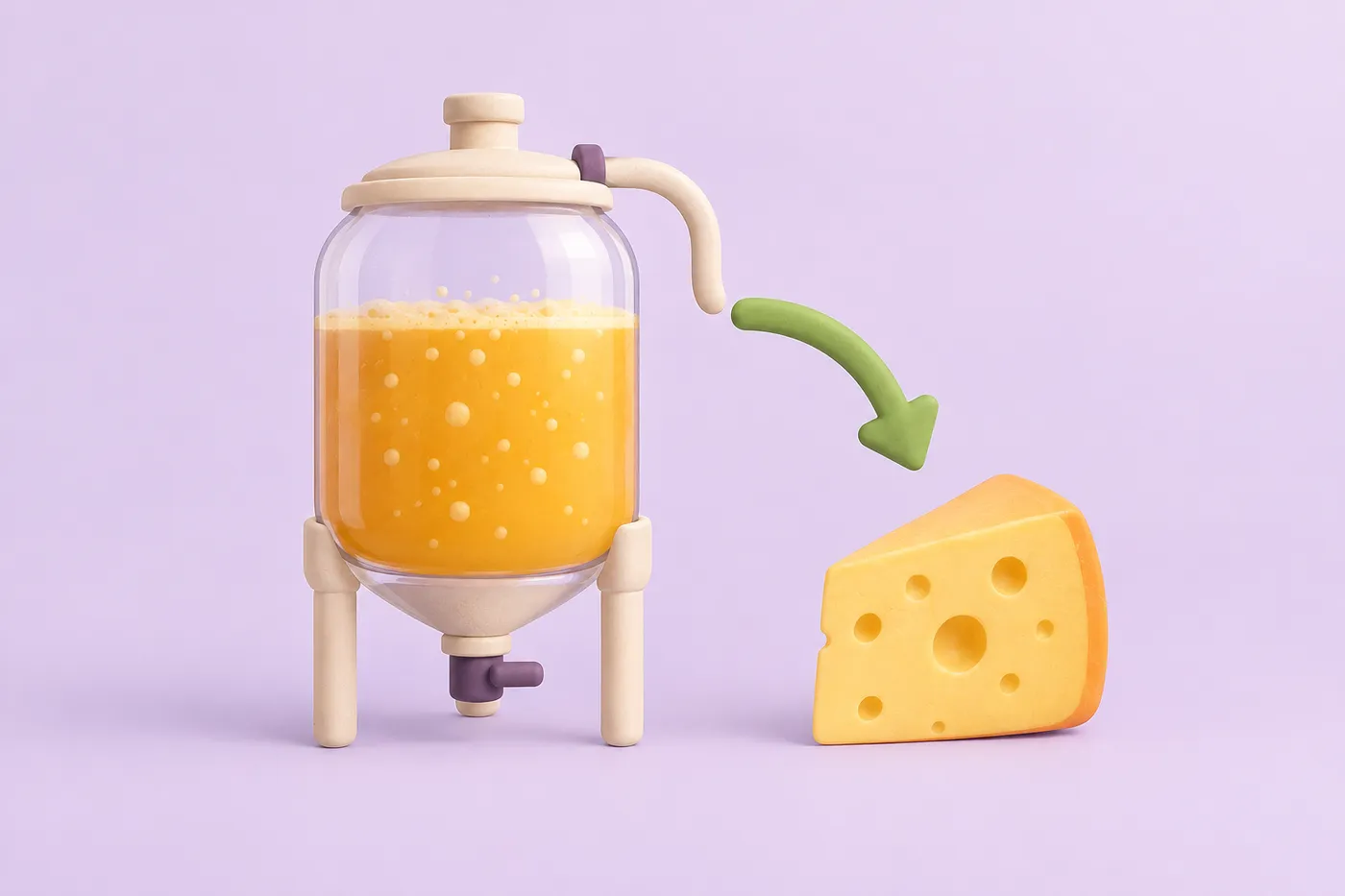
This matters for the vegan question specifically because a vegan standard is defined by how something was produced rather than by its molecular identity. A fermentation-made casein that is chemically identical to the dairy-derived version can meet that standard even though ordinary casein cannot. The molecule stays the same. Where it was made is what changes.
What this does and doesn’t mean for your grocery list
Don’t expect to find fermentation-made casein in a supermarket aisle this year.
A 2025 review of dairy-alternative biotechnology reports that precision-fermented casein and whey have reached 95 to 99% sequence identity with the natural proteins, genuinely close to the real thing at the molecular level. But the same review states that substantial barriers remain in replicating higher-order structures like casein micelles, and that the technology has not reached large-scale commercial dairy production.[8]
95-99% sequence identity between precision-fermented and natural casein PMID 41821689
Cost is the other half of the gap. The same review puts current production costs for precision-fermented milk proteins at $210 to $310 per kilogram, against $15 to $25 per kilogram for conventional dairy protein.[8]
Production cost per kilogram
Precision-fermented milk protein versus conventional dairy protein.
That is roughly a tenfold cost difference, which is exactly why almost all of the casein in the food supply today is still ordinary, dairy-derived casein rather than a fermentation-made substitute.
A few practical points follow from all of this:
- “Non-dairy” and “lactose-free” are not casein claims. Caseinate is a separate additive from lactose, and it can turn up in products marketed around the lactose question rather than the casein one. If you are scanning a label for either, the EatMatrix app reads the actual ingredient panel rather than the front-of-box marketing.
- “Lab-made casein” is real, published research, years away from being a purchasable ingredient. The science is sound. The supply chain is not there.
- If a product needs to be dairy-free for medical reasons (allergy or intolerance), check the ingredient list instead of the front label. Casein, caseinate, and whey can all appear under names that do not obviously say “dairy.”
Casein joins a pattern that comes up every time someone asks whether a milk-derived ingredient is vegan, lactose fails for the same reason, and cream cheese fails for a few more reasons layered on top. Even ingredients that sound like they might be a gray area, like starter cultures, come down to the same question: where did this come from, and who or what made it. For casein, the honest answer today is still a cow. The honest footnote is that it might not stay that way.
This article summarises publicly available regulatory assessments and peer-reviewed research about food ingredients. It is general information and is not intended to diagnose, treat, cure, or prevent any disease, and it is not personalised dietary or medical advice. Regulatory positions change; the EatMatrix app reflects the current assessments in our database. If you have an allergy, a medical condition, or are pregnant, talk to a qualified clinician or dietitian before changing what you eat.
References
- The structure of the casein micelle of milk and its changes during processing.. Annual review of food science and technology, 2012.
- Effects of Ultra-High-Pressure Jet Processing on Casein Structure and Curdling Properties of Skimmed Bovine Milk.. Molecules (Basel, Switzerland), 2023.
- Invited review: Caseins and the casein micelle: their biological functions, structures, and behavior in foods.. Journal of dairy science, 2013.
- Whey protein membrane processing methods and membrane fouling mechanism analysis.. Food chemistry, 2019.
- Position document: IgE-mediated cow's milk allergy.. Allergologia et immunopathologia, 2015.
- Downstream Processing of Food Proteins from Precision Fermentation.. Annual review of food science and technology, 2026.
- Production of phosphorylated and functional αs1-casein in Escherichia coli.. Trends in biotechnology, 2025.
- Biotechnology Approaches to Dairy Alternatives Through Precision Fermentation and Cellular Agriculture.. Food science of animal resources, 2025.
Frequently asked questions
Is casein vegan?⌄
No. Casein is milk's dominant protein, and the majority of the protein in cow's milk is contained in casein micelles, so it fails a vegan standard regardless of how it is processed afterward.
Is lab-made casein vegan?⌄
Precision-fermented casein is made by engineered microorganisms rather than an animal, so it can meet a vegan standard because veganism is defined by how something was produced. It has reached 95 to 99% sequence identity with natural casein in research, but it is not yet a purchasable product.
Does non-dairy or lactose-free mean a product has no casein?⌄
No. Caseinate is a separate additive from lactose, and it can turn up in products marketed around the lactose question rather than the casein one.
Is casein the same as whey?⌄
No. Casein and whey are both animal-derived milk proteins, but casein forms the micelles that curdle into cheese, while whey is the byproduct left in the liquid once casein has curdled out.
Is a casein allergy the same as lactose intolerance?⌄
No. Cow's milk allergy is an IgE-mediated immune reaction to milk proteins including casein, estimated at 1.6 to 3% of children, while lactose intolerance is an enzyme deficiency affecting milk sugar digestion with no immune involvement.
More like this, by email
A weekly email with our new research-backed guides. No spam, unsubscribe any time.


