Gut Bacteria Evolved to Eat Xanthan Gum. The Scares Never Caught Up
· 6 min read
Written and fact checked by EatMatrix Research Team
Food-additive research team at MAXHUMAN, MB, makers of the EatMatrix scanner
Every claim links to a primary source. Regulatory positions cite EFSA, FDA and WHO/JECFA opinions current at publication.
TL;DR
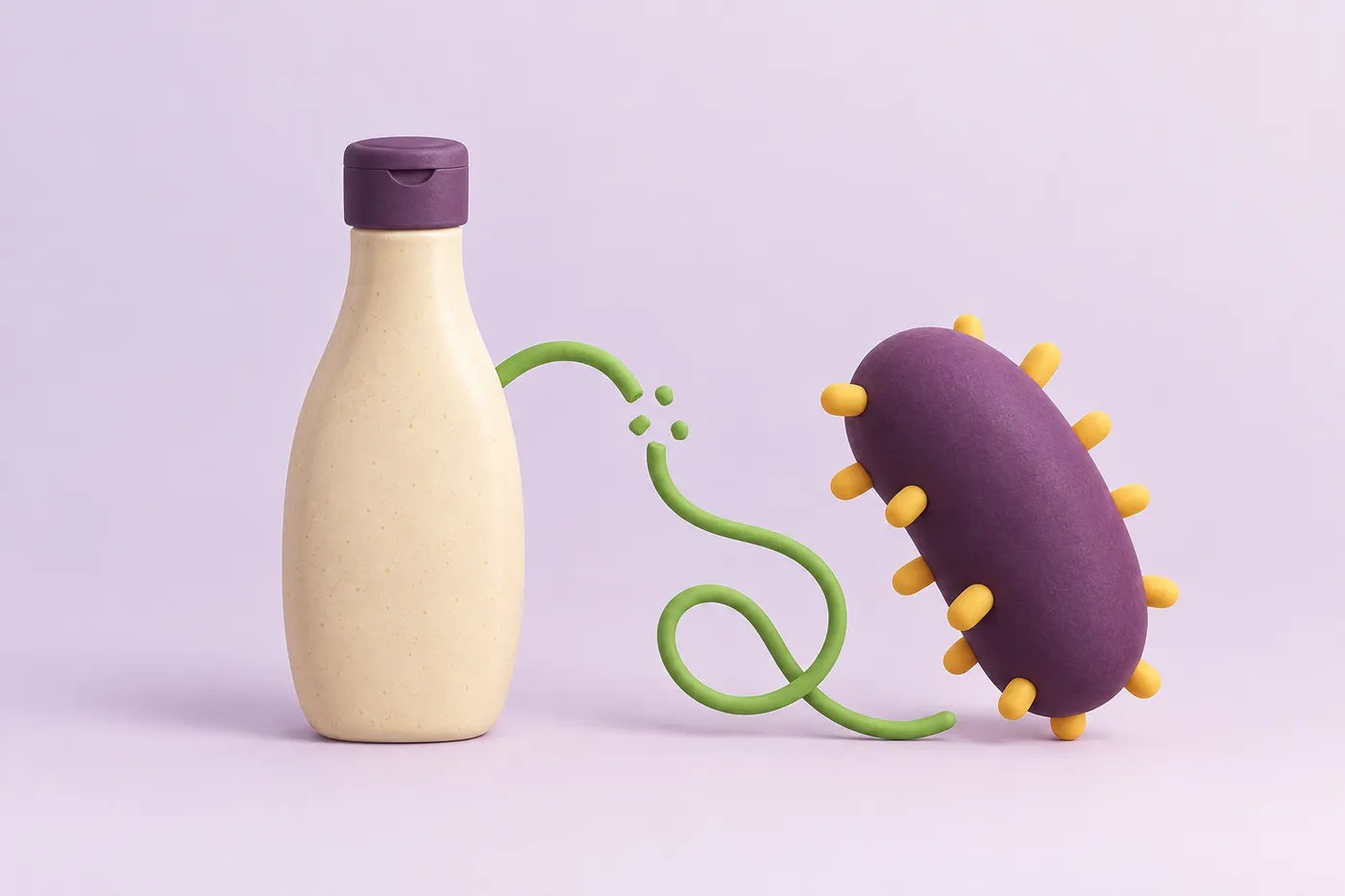
Xanthan gum is safe at the levels used in food, and EFSA's 2017 review set no numerical intake limit after finding only mild stomach discomfort at triple the highest real-world exposure. The genuinely surprising finding is a 2022 study showing a gut bacterium evolved specifically to digest it, and the mouse study often cited as a warning actually describes that additive protecting mice from a dangerous gut infection.
Key takeaways
- EFSA found no safety concern and set no numerical daily limit for xanthan gum in food
- A 2022 study identified a single gut bacterium that evolved to digest xanthan gum
- The human tolerance ceiling (214 mg/kg bw/day) is about triple real-world food exposure
- A widely cited mouse study actually shows xanthan gum protecting against a gut infection, not causing harm
- The one real caution point is for concentrated medical thickeners given to premature infants, not food
Understand the ingredients on your next food label.
Use EatMatrix on your iPhone to scan an ingredient list and explore the ingredient information in the app. Start with a label you already have.
Get EatMatrix for iPhoneOn this page
Xanthan gum is safe to eat at the amounts used in food. EFSA’s 2017 safety review of the additive found no safety concern for the general population and concluded there was no need for a numerical limit on daily intake, because even repeated high doses in human testing produced nothing worse than an upset stomach.[1]
The real story about this ingredient isn’t a hidden danger. It’s that part of your gut microbiome has a job specifically built around eating it. A 2022 study found a single bacterium that breaks xanthan gum apart for a living, something no one had documented before processed food gave it a reason to exist.[2] That’s the detail worth repeating at dinner, not the mouse studies that get recycled into scare posts.
Where xanthan gum comes from
The name sounds synthetic, which is most of why it gets flagged as suspicious on ingredient lists, but the chemistry behind it is closer to brewing than to manufacturing.
Xanthan gum is made by fermenting bacteria of the genus Xanthomonas in a tank of glucose, sucrose or starch, the same basic process that turns milk into yogurt or cabbage into sauerkraut, just with a different microbe and a different end product.[3] The bacteria consume the sugar and excrete a long, thick polysaccharide chain. That chain gets filtered, dried and ground into the powder that thickens salad dressing.
What happens instead: a fermentation byproduct forms, the same basic category as vinegar or a sourdough starter, just scaled up to industrial volume rather than built from a petroleum derivative or a lab-synthesized polymer assembled molecule by molecule in a chemical plant.
xanthan gum (E415) links to a thickener family that includes guar gum and locust bean gum. All three share the same basic fate once swallowed: none of them are digested the way starch is.
The bacterium that evolved to eat it
Here’s the part that surprised the researchers who found it. Most dietary fiber gets broken down by gut bacteria using enzyme systems that evolved over millions of years to handle plant material. Xanthan gum has only existed in the human food supply since the 1960s. There shouldn’t have been time for anything to adapt to it.
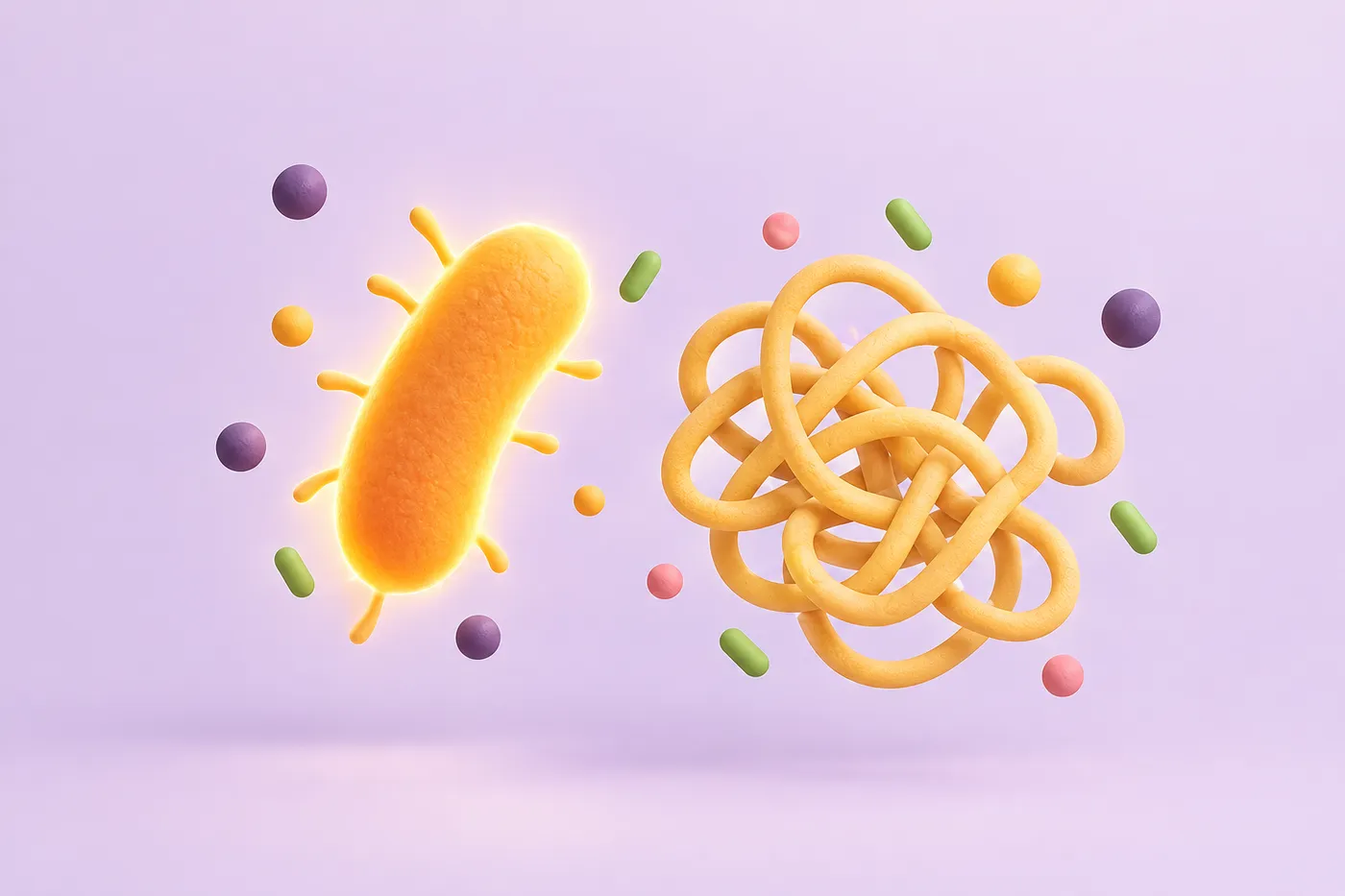
But something did. Researchers sequencing human gut microbiomes found that the ability to digest xanthan gum is common in people from industrialized countries, and traced it to a single, previously uncultured bacterium in the family Ruminococcaceae. That bacterium cleaves the xanthan backbone first, and a second species, Bacteroides intestinalis, feeds on the leftover fragments it can’t fully process alone.[2]
The researchers confirmed this by feeding xanthan gum to germ-free mice colonized with human gut bacteria, and watched the Ruminococcaceae population expand specifically in response.[2]
The surprising fact: before this bacterium was identified, xanthan gum was assumed to pass through the gut largely untouched, the way a lot of dietary fiber does.[2] Instead, something in the microbiome had already found a way to use it.
This isn’t unique to xanthan gum. It’s the same evolutionary logic behind lactose tolerance: introduce something new into a population’s diet, and sooner or later, something in the body or the microbiome figures out how to exploit it. Xanthan gum just did it faster, within a few human generations instead of thousands of years.
The mouse study people cite doesn’t say what they think
Search around and you’ll find a 2020 mouse study used as proof that xanthan gum harms the gut. Read past the headline and the dose, and it argues the opposite.
Mice were fed a diet containing 5% xanthan gum by weight, a dose far beyond anything a person eats from processed food, and researchers tracked what happened to their gut bacteria during antibiotic treatment.[4] The xanthan gum diet increased fiber-degrading bacteria and short-chain fatty acid production, preserved microbiota diversity while the mice were on antibiotics, and limited colonization by Clostridioides difficile, the bacterium responsible for one of the most dangerous hospital-acquired gut infections.[4]
That’s a protective effect, in mice, at a dose no one encounters at the grocery store. It is not evidence of colonic damage.
Three studies, three different questions about xanthan gum
| Study | Who or what was tested | Dose used | What it found |
|---|---|---|---|
| Ostrowski et al., 2022 (Nature Microbiology) | Human gut microbiome samples; germ-free mice | Ordinary dietary xanthan gum | A single gut bacterium evolved specifically to digest it |
| Schnizlein et al., 2020 (mSphere) | Mice | 5% of total diet | Protected gut bacteria diversity, resisted a dangerous infection |
| EFSA Panel, 2017 | Adult volunteers | 214 mg per kg body weight per day for 10 days | Well tolerated; mild stomach discomfort in some, no lasting harm |
Population, dose and real finding for the studies behind this article.
What a typical dose in food looks like
The EFSA review didn’t stop at “no safety concern.” It put numbers behind that conclusion.
- Everyday exposure: general-population intake from ordinary food was estimated at up to 64 mg per kg of body weight per day in children, the highest-consuming group.[1]
- Medical formula exposure: infants on special formulas designed for medical conditions were estimated at up to 115 mg per kg per day, still within the margin EFSA judged safe.[1]
- The tolerance ceiling: in a ten-day human trial, adults taking 214 mg per kg of body weight per day, roughly triple the highest real-world exposure figure, tolerated it well. Some reported abdominal discomfort. None had a serious adverse event.[1]
214 mg/kg the daily human dose, sustained for 10 days, that caused only mild stomach discomfort in some volunteers PMID 32625570
Nobody eating cereal, salad dressing or gluten-free bread is getting anywhere close to that ceiling. The amount of xanthan gum on an ingredient list, on its own, tells you nothing about risk, because the dose that produced any discomfort at all sits well above what food delivers.
What the evidence doesn’t settle
Nobody has run a long-term human trial tracking everyday, whole-food-level xanthan gum intake, the few grams a week spread across dressing, yogurt and packaged bread, against digestive health outcomes over years. That’s a real gap. It isn’t evidence of harm hiding behind a research gap, it’s just a study nobody has funded, because the existing toxicology and exposure data didn’t raise a reason to.
Where the real caution point sits
Xanthan gum’s dose profile does matter for one specific population: premature infants given concentrated, medical-grade thickeners for feeding difficulties, a different product entirely from the additive in a bottle of ranch dressing. We’ve covered that narrower, genuinely serious question in detail here: E415 Xanthan Gum: The Real Warning Is for Infants, Not Adults.
For everyone else reading a label at the grocery store, that risk doesn’t apply. It belongs to a hospital feeding protocol, something a grocery-aisle ingredient list has nothing to do with.
Bottom line: xanthan gum is a fermentation product cleared by EFSA with no numerical intake limit, your gut may already host a bacterium built to digest it, and the mouse study circulating as a warning describes a protective effect at a dose nobody eats.
What this means for reading the label
Seeing “xanthan gum” on an ingredient list isn’t a reason to put the product back on the shelf. The ingredient has decades of regulatory review behind it, a documented safety margin several times wider than real exposure, and now a plausible biological explanation for why most people handle it without issue.
If you notice bloating after a very high intake of a fiber-like thickener, that’s a personal tolerance and dose question, the same way some people react to too much inulin or too many beans in one sitting. It isn’t evidence the ingredient list was hiding something from you. Food additives to avoid: the two with real trial evidence covers the additives where the evidence points the other way, and maltodextrin’s mouse-study problem is worth reading if this pattern, a scary-looking animal study doing a lot of work it can’t support, sounds familiar.
Next time a label scan flags xanthan gum, the EatMatrix app will tell you the same thing this article does: what matters is the dose and where it came from.
This article summarises publicly available regulatory assessments and peer-reviewed research about food ingredients. It is general information and is not intended to diagnose, treat, cure, or prevent any disease, and it is not personalised dietary or medical advice. Regulatory positions change; the EatMatrix app reflects the current assessments in our database. If you have an allergy, a medical condition, or are pregnant, talk to a qualified clinician or dietitian before changing what you eat.
References
- Re-evaluation of xanthan gum (E 415) as a food additive.. EFSA journal. European Food Safety Authority, 2017.
- Mechanistic insights into consumption of the food additive xanthan gum by the human gut microbiota.. Nature microbiology, 2022.
- Sources and methods of manufacturing xanthan by fermentation of various carbon sources.. Biotechnology progress, 2023.
- Dietary Xanthan Gum Alters Antibiotic Efficacy against the Murine Gut Microbiota and Attenuates Clostridioides difficile Colonization.. mSphere, 2020.
Frequently asked questions
Is xanthan gum bad for you?⌄
No. EFSA's 2017 safety review found no safety concern for the general population at the levels used in food and did not set a numerical intake limit, because even much higher test doses caused nothing worse than mild stomach discomfort in some people.
Is xanthan gum a chemical?⌄
It is made by fermenting bacteria of the genus Xanthomonas with glucose, sucrose or starch, the same basic process as turning milk into yogurt or cabbage into sauerkraut, not a petroleum derivative or a lab-synthesized polymer.
Can your body digest xanthan gum?⌄
A 2022 study found that a single, previously uncultured gut bacterium in the family Ruminococcaceae has evolved specifically to break xanthan gum down, something that was not known before that research.
Does xanthan gum cause digestive problems?⌄
At the doses used in food, no serious adverse effects have been documented. A mouse study sometimes cited as evidence of harm actually used a much higher dose and found xanthan gum protected gut bacteria diversity and reduced a dangerous infection, not the reverse.
Is xanthan gum safe for babies?⌄
Ordinary food containing xanthan gum is not the concern. The real caution applies to concentrated medical thickeners given to premature infants for feeding difficulties, a different product and dose covered in a separate article on that specific risk.
More like this, by email
A weekly email with our new research-backed guides. No spam, unsubscribe any time.