E415 Xanthan Gum: The Real Warning Is for Infants, Not Adults
· 6 min read
Written and fact checked by EatMatrix Research Team
Food-additive research team at MAXHUMAN, MB, makers of the EatMatrix scanner
Every claim links to a primary source. Regulatory positions cite EFSA, FDA and WHO/JECFA opinions current at publication.
TL;DR
Xanthan gum (E415) has clean EFSA and FDA safety records for ordinary food use, with no numeric daily intake limit set. The one documented downside is concentrated, clinical-strength thickened feeds given to premature infants, not the small amounts used in salad dressing or gluten-free bread.
Key takeaways
- EFSA's 2017 review found no safety concern up to 64 mg per kg body weight per day in children
- No numerical acceptable daily intake was set because the safety margin is so wide
- FDA approved xanthan gum for food and pharmaceutical use back in 1969
- Necrotizing enterocolitis case reports involve a concentrated infant thickener, not food-additive doses
- No xanthan-gum-specific human trial was found for its effect on blood sugar or cholesterol
Understand the ingredients on your next food label.
Use EatMatrix on your iPhone to scan an ingredient list and explore the ingredient information in the app. Start with a label you already have.
Get EatMatrix for iPhoneOn this page
Xanthan gum, the E415 on the ingredient list of your salad dressing, your gluten-free bread, and half the bottles in your shower, is not the additive you need to worry about at the dinner table. EFSA reviewed it in 2017, found no safety concern for the general population at the way it’s used in food, and didn’t even think it needed a numeric daily limit.[1]
The real caution with xanthan gum belongs to a hospital nursery, not a supermarket aisle. Thickened feeds given to premature infants with swallowing problems, a specific product for a specific vulnerable population, have been linked to a serious bowel illness in published case reports.[2] Confuse the two and you either panic about your vinaigrette for no reason, or you miss the one population that needs the warning.
What EFSA and the FDA concluded
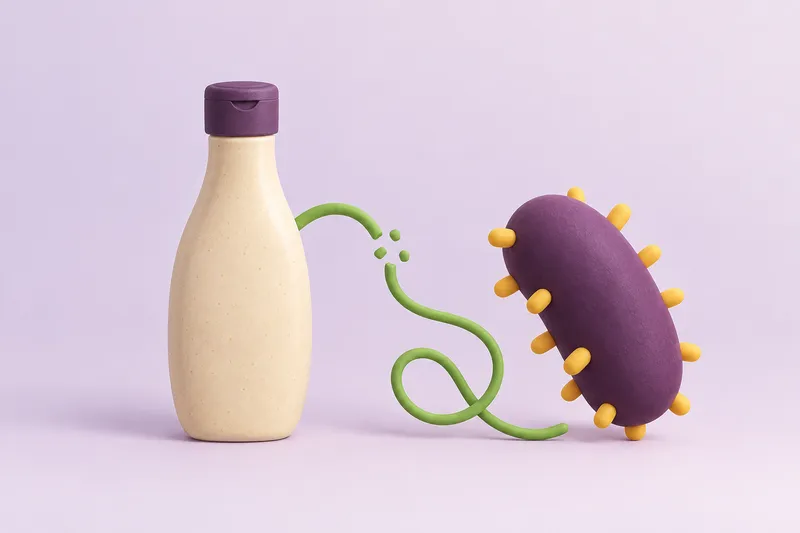
Xanthan gum is a polysaccharide manufactured by fermenting a carbohydrate source with the bacterium Xanthomonas campestris, then purifying and drying the resulting gum.[3] It’s been part of the American food supply since the FDA approved it for use in food and pharmaceutical products in 1969, back when using bacteria to manufacture a food ingredient still sounded exotic.[4]
The European record is more recent and more detailed. EFSA’s Panel on Food Additives re-evaluated xanthan gum (E415) in 2017, working from an estimated exposure of up to 64 mg per kilogram of body weight per day in children, the group that eats the most food additives relative to its size.
64 mg/kg estimated daily xanthan gum exposure in children, EFSA's 2017 refined assessment PMID 32625570
The panel found no adverse effects at the highest doses tested in its long-term feeding and cancer studies, and concluded there is no safety concern at that exposure.[1] It also decided xanthan gum didn’t need a numerical acceptable daily intake at all, the designation regulators reserve for additives whose safety margin is wide enough that a hard number isn’t useful.[1]
How xanthan gum behaves once it’s in your gut
Once swallowed, xanthan gum does something most starches don’t: it resists being broken down. Reviews describe it as a non-digestible carbohydrate rather than one your digestive enzymes dismantle in the small intestine, a property that underlies its potential as a prebiotic substrate.[5] Because it resists digestion earlier in the gastrointestinal tract, it’s considered a candidate substrate for gut bacteria, giving it prebiotic potential similar to other natural gums such as guar gum and gum arabic.[5]
The theory that follows is straightforward. A thick, gel-forming, undigested polysaccharide sitting in your gut should slow how fast a meal empties from your stomach and how quickly its glucose gets absorbed. It’s the same basic trick behind some extended-release medications, where a gel-forming polymer coating slows a drug’s release into the bloodstream instead of dumping it all at once.
That mechanism is plausible. What’s missing is a xanthan-gum-specific human trial that tested it against a clear outcome:
- Blood sugar: we could not find a trial isolating xanthan gum’s effect on the post-meal rise in blood glucose.
- Cholesterol: we could not find a trial isolating xanthan gum’s effect on serum cholesterol.
- Long-term disease risk: no large, long-running trial has tested whether everyday dietary exposure to xanthan gum as a thickener changes disease risk at the population level.
What we couldn’t confirm: despite a plausible mechanism, no human trial in our search isolated xanthan gum’s own effect on blood sugar, cholesterol, or long-term disease risk. If someone tells you it measurably lowers either one, ask for the trial.
The one real warning: xanthan gum and premature infants
Here’s the honest downside, and it doesn’t involve your pantry. A case report described three premature infants who developed necrotizing enterocolitis, an unusual, late-onset form that affects the colon, after being fed a xanthan-gum-based thickener sold as SimplyThick and used to manage swallowing difficulty and reflux.[2]
3 premature infants in the published case report linking a xanthan-gum thickener to necrotizing enterocolitis PMID 22289705
The same case report notes something worth remembering: xanthan gum isn’t just a thickener, it’s also an effective laxative, which helps explain why concentrated exposure in a fragile digestive system behaved so differently than a teaspoon in a salad dressing.[2]
That’s:
- A specific product: a concentrated xanthan-gum thickener marketed for feeding therapy, not a food-additive dose.
- A specific clinical use: managing swallowing difficulty and reflux in infants who can’t feed safely otherwise.
- A specific population: infants born prematurely, whose intestines are still developing.
Bottom line on the infant warning: the concern is documented for concentrated, clinical-strength thickened feeds in premature infants, not for the small amounts of xanthan gum stabilizing food eaten by children or adults.
EFSA revisited the infant question directly. Prompted by gaps in the available clinical data for the youngest infants, its 2023 follow-up review recalculated the safety margin using data from neonatal piglet studies and still concluded there were no safety concerns for xanthan gum’s approved uses, including in specialized formula for infants under 16 weeks old.[6] That’s a narrower, different question, approved food-additive use levels in formula, than the SimplyThick case reports, concentrated, therapy-strength thickening. But it’s the closest regulatory word on record for this age group.
Where it fits next to guar gum
Compare xanthan gum’s evidence base to guar gum’s and the difference is stark. A randomized, double-blind, placebo-controlled trial gave adults with a tendency toward loose stools a partially hydrolyzed form of guar gum and found it normalized stool form and increased Bifidobacterium abundance, a therapeutic effect measured directly in a human trial.[7] Xanthan gum doesn’t have an equivalent human trial behind its own digestive effects, at least not one we could locate.
The comparison isn’t all in guar gum’s favor. A mouse study of colitis tested four food hydrocolloids side by side and found guar gum, alongside pectin, increased short-chain-fatty-acid-producing gut bacteria and eased colitis symptoms, while xanthan gum did neither. It didn’t meaningfully improve colitis in the mice, and it increased the abundance of a bacterium, Ruminococcus gnavus, whose levels tracked with worse colitis severity in that same model.[8] That’s a mouse finding, not a human one, and colitis is a specific inflamed-gut condition, not a general statement about everyone’s microbiome. It’s still a real data point against treating every “natural gum” as interchangeable.
Xanthan gum vs guar gum, at a glance
| Xanthan gum (E415) | Guar gum (E412) | |
|---|---|---|
| Typical use level | A fraction of a percent of a recipe's weight | Higher concentration needed for the same thickening |
| Direct human digestive trial | None found in our search | Randomized, double-blind trial in adults prone to loose stools |
| Mouse colitis model | Did not improve colitis; raised a bacterium linked to worse severity | Improved colitis alongside pectin |
| Documented downside | Necrotizing enterocolitis case reports tied to concentrated infant thickener use | None identified in the sources reviewed for this article |
Based on the sources cited in this article.
It’s a pattern we’ve seen with other additives too: the ingredient itself checks out, and the real story is a specific use, a specific dose, or a specific population. We covered a similar case with sodium benzoate, where the additive isn’t the danger and what it reacts with is.
What’s still unsettled
Long-term human data on how habitual xanthan gum intake, at ordinary food-additive levels, shapes the gut microbiome over months or years is something our search didn’t turn up, and that’s a genuine gap rather than a reason for concern. The mouse colitis finding above is exactly the kind of result that would need a human follow-up before it means much for your own gut.[8]
If you have inflammatory bowel disease, that gap is worth raising with your own doctor rather than reasoning from a mouse study on your own. For an additive with a messier human data set than xanthan gum’s, see our breakdown of E322 lecithin, where the real risk turned out to be the choline load, not the additive itself. And if what you want is a list of additives with real trial evidence behind a specific risk, we’ve covered the two that qualify; xanthan gum, on the evidence we found, isn’t one of them.
The bottom line on xanthan gum
Xanthan gum earns its EFSA and FDA clearance for ordinary food use, and the case against it in a salad dressing or a gluten-free loaf doesn’t exist in the research we found. The one place caution is genuinely warranted is concentrated, clinical-strength thickened feeds for premature infants, a use case most people reading an ingredient label will never touch.
Bottom line: Xanthan gum is safe at ordinary food-additive levels for the general population. The genuine caution applies to concentrated, clinical-strength thickened feeds in premature infants, not to the amount in your dressing or bread.
Skip the fear about your vinaigrette. Save it, if you need to save it anywhere, for a hospital feeding chart. Next time E415 shows up on a label, scan it with the EatMatrix app and get that verdict without having to remember any of this.
This article summarises publicly available regulatory assessments and peer-reviewed research about food ingredients. It is general information and is not intended to diagnose, treat, cure, or prevent any disease, and it is not personalised dietary or medical advice. Regulatory positions change; the EatMatrix app reflects the current assessments in our database. If you have an allergy, a medical condition, or are pregnant, talk to a qualified clinician or dietitian before changing what you eat.
References
- Re-evaluation of xanthan gum (E 415) as a food additive.. EFSA journal. European Food Safety Authority, 2017.
- Development of necrotizing enterocolitis in premature infants receiving thickened feeds using SimplyThick®.. Journal of perinatology : official journal of the California Perinatal Association, 2012.
- Xanthan gum in aqueous solutions: Fundamentals and applications.. International journal of biological macromolecules, 2022.
- Sources and methods of manufacturing xanthan by fermentation of various carbon sources.. Biotechnology progress, 2023.
- Natural gums (gum Arabic, guar gum and xanthan gum) as a promising source of prebiotics: a review on their functional roles and food applications.. International journal of biological macromolecules, 2025.
- Re-evaluation of xanthan gum (E 415) as a food additive in foods for infants below 16 weeks of age and follow-up of its re-evaluation as a food additive for uses in foods for all population groups.. EFSA journal. European Food Safety Authority, 2023.
- Effect of Repeated Consumption of Partially Hydrolyzed Guar Gum on Fecal Characteristics and Gut Microbiota: A Randomized, Double-Blind, Placebo-Controlled, and Parallel-Group Clinical Trial.. Nutrients, 2019.
- Effects of four food hydrocolloids on colitis and their regulatory effect on gut microbiota.. Carbohydrate polymers, 2024.
Frequently asked questions
Is xanthan gum (E415) FDA approved?⌄
Yes. The FDA approved xanthan gum for use in food and pharmaceutical products in 1969.
Does xanthan gum have an acceptable daily intake?⌄
No numerical ADI was set. EFSA's 2017 re-evaluation concluded the safety margin was wide enough that a specific daily limit was not necessary.
Is xanthan gum safe for babies?⌄
Ordinary food-additive use is treated as safe, including in infant formula that EFSA reassessed in 2023. The documented concern is concentrated, clinical-strength thickened feeds given to premature infants, which case reports have linked to necrotizing enterocolitis.
Does xanthan gum affect blood sugar or cholesterol?⌄
There is a plausible mechanism, since its viscosity could slow gastric emptying and glucose absorption, but no human trial isolating xanthan gum's own effect on blood sugar or cholesterol was found.
Is xanthan gum better or worse than guar gum?⌄
Guar gum has more direct human trial evidence for digestive effects and performed better in a mouse colitis study, while xanthan gum needs a smaller amount to achieve the same thickening.
More like this, by email
A weekly email with our new research-backed guides. No spam, unsubscribe any time.