Is Vitamin D Vegan? It Depends Which Bottle You Buy
· 6 min read
Written and fact checked by EatMatrix Research Team
Food-additive research team at MAXHUMAN, MB, makers of the EatMatrix scanner
Every claim links to a primary source. Regulatory positions cite EFSA, FDA and WHO/JECFA opinions current at publication.
TL;DR
Most vitamin D3 supplements are not vegan, because cholecalciferol is commonly manufactured from lanolin, the grease in sheep's wool. Vitamin D2 is vegan by default but raises blood vitamin D levels less effectively than D3, and a non-animal D3 from lichen exists in research but is not yet a mainstream supplement source. For almost everyone, sunlight exposure and supplement choice matter far more for vitamin D status than diet alone.
Key takeaways
- Most vitamin D3 comes from lanolin, sheep's wool grease, making it non-vegan
- Vitamin D2 is vegan by default but raises blood levels less than D3
- Lichen-derived D3 exists in research but is not yet a mainstream supplement source
- Fortified foods and sunlight matter more than diet pattern for vitamin D status
- A plain vitamin D3 label with no vegan claim should be assumed animal-derived
Understand the ingredients on your next food label.
Use EatMatrix on your iPhone to scan an ingredient list and explore the ingredient information in the app. Start with a label you already have.
Get EatMatrix for iPhoneOn this page
- Why most vitamin D3 isn’t vegan
- The lichen exception, still more lab bench than supermarket shelf
- D3 raises your blood levels more than D2 does
- Why the sourcing question stops mattering once you swallow it
- What the vegan-diet studies on kids found
- Sunlight does more than your diet does, vegan or not
- Food fortification already closes part of the gap
- The real risk is deficiency, not the diet label
- What to check on the label
- References
Vitamin D3 is usually not vegan. Most capsules on the shelf are cholecalciferol pulled from lanolin, the grease sheep secrete into their wool [1]. Vitamin D2 is vegan by default because it comes from UV-irradiated yeast or mushrooms [2], but it is a weaker performer in your bloodstream [3]. A non-animal D3 is emerging from lichen research, though it is not yet a mainstream supplement ingredient [4]. None of that changes the bigger point: for almost everyone, vegan or not, diet is a minor player next to sunlight and supplementation in keeping vitamin D levels where they should be [5].
Why most vitamin D3 isn’t vegan
A 2023 review of animal-derived content in common medications spells it out plainly: cholecalciferol manufacture involves the use of lanolin from sheep’s wool [1]. That review was checking which everyday UK medicines quietly fail a vegan test, and vitamin D3 was one of the ones it flagged.
This is the same trick that makes most cheese non-vegetarian. Rennet, an animal enzyme, is the ingredient doing the work. Nothing visible on the front of the tub gives it away. Is Cream Cheese Vegan? No, and Here’s What’s In the Tub runs through that case in detail. Vitamin D3 and lanolin are the supplement-aisle version of the same problem.
Vitamin D2 dodges it entirely. It’s made by shining UV light on ergosterol in yeast or mushrooms, an inherently plant-and-fungus-derived route [2]. The European Union specifically approved UV-irradiated baker’s yeast as a Novel Food ingredient so manufacturers could fortify bread and baked goods with D2 for exactly this reason [2].
The surprising part: the vitamin molecule itself isn’t the problem. D3 is fat-soluble and odorless regardless of where it comes from. The extraction process is what makes a capsule non-vegan. The vitamin’s chemistry has nothing to do with it.
The lichen exception, still more lab bench than supermarket shelf
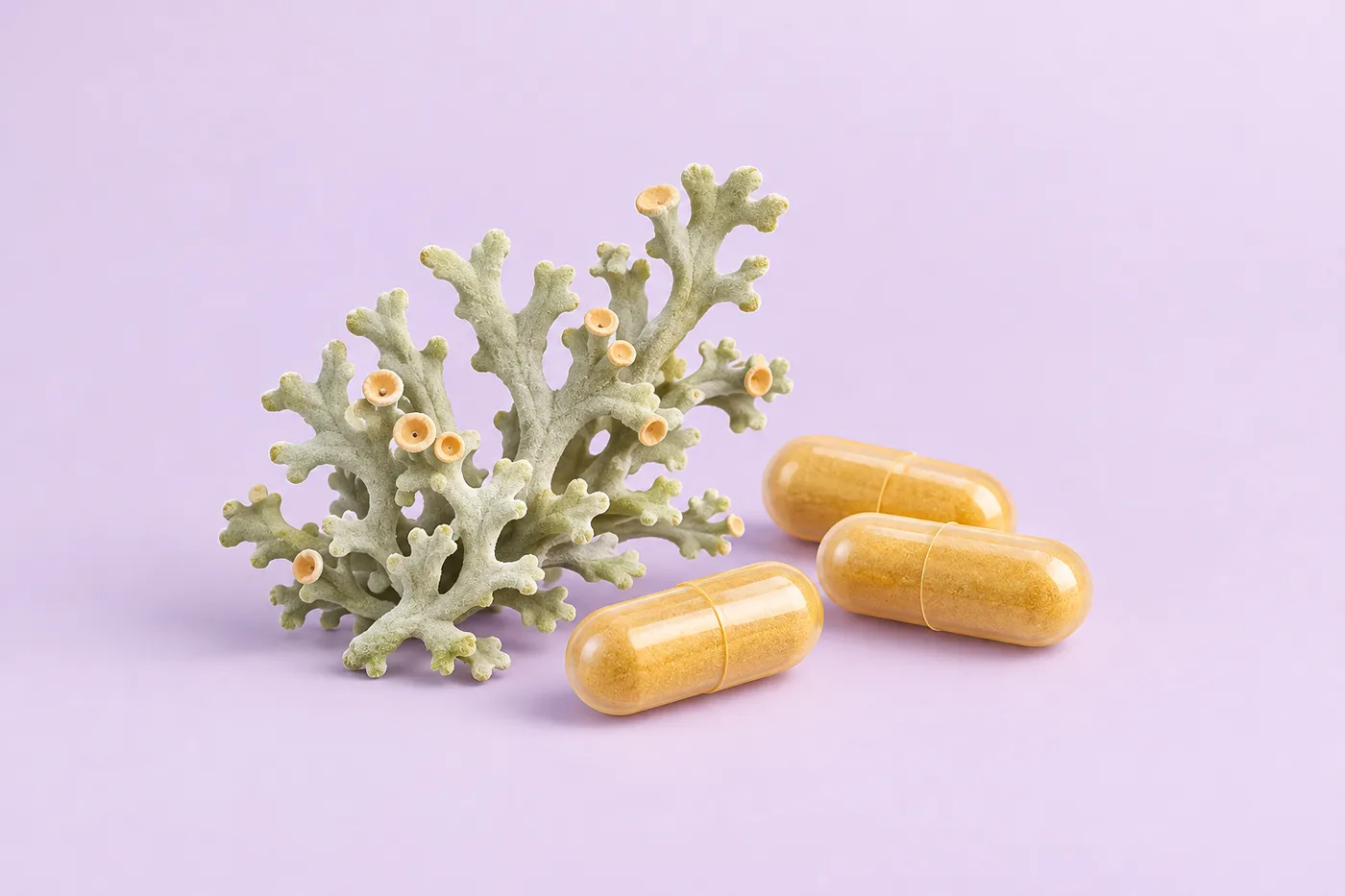
Research on epiphytic lichen species has identified them as a non-animal source of vitamin D3, with content varying widely by species and extraction method, from 0.6 to 20.33 micrograms per gram in one 2025 survey, making lichen a candidate source for vegan D3 production rather than an established mainstream one [4].
20.33 micrograms of vitamin D3 per gram, the highest-yielding lichen species in a 2025 survey PMID 40915670
That’s a real non-animal source of the more effective D form. It is not, yet, a shelf full of lichen-D3 supplements. The research describes lichen as a candidate biosource for pharmaceutical and nutraceutical use, which is a step before it shows up at commercial scale [4]. If a label claims vegan D3, lichen extraction is plausibly how, but check the label rather than assume it.
D3 raises your blood levels more than D2 does
Sourcing aside, D2 and D3 are not interchangeable once they’re in your system. A systematic review and meta-analysis of randomized trials found that vitamin D3 supplementation raised serum 25-hydroxyvitamin D significantly more than equal doses of D2 [3]. The gap was largest when the vitamin was given as an infrequent bolus dose rather than a daily one [3].
A newer 2024 meta-analysis of 20 head-to-head trials, dosed daily or once to twice weekly, confirmed it: D3 outperformed D2 at raising total 25-hydroxyvitamin D, even though both forms raised their own corresponding metabolite fraction about equally [6].
D2 vs D3, by source and performance
| Form | Typical source | Vegan by default | Effect on blood vitamin D |
|---|---|---|---|
| D2 (ergocalciferol) | UV-irradiated yeast or mushrooms | Yes | Raises levels, less effectively than D3 |
| D3 (cholecalciferol) | Lanolin from sheep's wool | No | Raises levels more effectively than D2 |
| D3, lichen-derived | Epiphytic lichen species | Yes | Same molecule as standard D3, still a research-stage source |
Based on the citations in this article.
For a vegan who wants the more effective D3 molecule rather than D2, lichen-sourced D3 is the thing to look for on a label, not a plain “vitamin D3” claim with nothing else stated.
Why the sourcing question stops mattering once you swallow it
Here’s the part that undercuts some of the drama around D2 versus D3: once either form is in your body, it goes through the same two-step activation before it does anything. The liver performs 25-hydroxylation, mainly through an enzyme called CYP2R1, and the kidney finishes the job with 1-alpha-hydroxylation through CYP27B1, producing calcitriol, the actual hormone your cells respond to [7].
Vegan or not, lichen or lanolin, that activation sequence doesn’t change. What changes is how efficiently the starting molecule converts into a form the liver can hydroxylate in the first place, which is the entire reason D3 outperforms D2 in the trials above.
What the vegan-diet studies on kids found
Readers specifically ask how bone and mineral metabolism compares across vegan, vegetarian and omnivorous households. That precise comparison does not have a verifiable published source behind it for this piece, so it’s left out rather than summarized secondhand. What does exist is vitamin D intake and blood status data, a related but not identical question.
A 2025 review pulled together nine studies of children aged 1 to 18 comparing vegetarian, vegan and omnivorous diets [8]. The pattern it found:
- Four studies reported lower vitamin D intake in vegetarian or vegan children compared with omnivores [8]
- Three studies reported lower blood 25-hydroxyvitamin D in vegetarian or vegan children [8]
- Three studies found no significant difference in blood levels between diet groups at all [8]
That split matters. These are observational comparisons of families who already chose a diet pattern, not trials that randomly assigned children to one. They can show an association between diet group and a nutrient marker. They cannot show that the diet itself caused any gap. A family that supplements and gets regular sun exposure can land anywhere on that spread, vegan or not.
Sunlight does more than your diet does, vegan or not
For most people, food is not actually where vitamin D comes from in the first place. Solar UVB radiation hitting skin initiates vitamin D3 synthesis directly, which the body then metabolizes into its active form [5]. That pathway has nothing to do with what’s on your plate.
Bottom line on sourcing: a vegan diet’s vitamin D adequacy depends far more on sun exposure and supplement choice than on any single food, animal-derived or not.
Food fortification already closes part of the gap
A 2024 systematic review and meta-analysis of randomized trials found that fortifying food vehicles such as bread, orange juice, UV-exposed mushrooms, milk, yogurt, cheese and eggs with vitamin D3 or D2 raised circulating 25-hydroxyvitamin D by roughly 9 to 35 nmol/L depending on the vehicle, with no significant difference between plant-based and animal-based vehicles overall [9].
Foods With Vitamin D Won’t Fix a Deficiency on Their Own goes deeper into why fortified food alone rarely gets anyone, vegan or omnivore, to an adequate level without supplementation or sun doing some of the work too.
The real risk is deficiency, not the diet label
A multi-society global consensus guideline on nutritional rickets lays out evidence-based recommendations for preventing and managing vitamin D and calcium deficiency in children generally, aimed at the whole pediatric population rather than one diet pattern [10]. Nobody’s diet label is the risk factor here. Prolonged, severe deficiency is, and that can happen on any diet that skips supplementation and sun.
No published human trial has isolated a vegan diet by itself, apart from vitamin D intake and sun exposure, as a direct cause of deficiency. The diet pattern and the nutrient are tangled together in every study that’s looked. That’s exactly why the intake-and-status data above is the useful takeaway here, rather than any verdict on veganism itself.
Vitamin D Isn’t Bad for You. Megadosing Is. covers the other side of this question: how much is too much, for anyone.
What to check on the label
A supplement that just says “vitamin D3” with no vegan or lichen-sourced claim should be assumed to use an animal-derived source until the label or manufacturer states otherwise. The absence of a vegan claim is itself informative. Brands that use lichen-derived D3 advertise it, because it costs more to produce and because vegan shoppers are the entire reason to use it.
If the goal is a vegan diet and the more effective D3 molecule, look for:
- “Vegan” or “plant-based” stated on the D3 label itself, not implied by the brand’s general marketing
- “Lichen-derived” or “algae-derived” in the ingredient list, the non-animal D3 sources that currently exist
- D2 as a fallback, if no vegan D3 is available and the modest efficacy difference is an acceptable trade
Scanning the ingredient panel yourself, or with the EatMatrix app, is the fastest way to catch this before checkout. This isn’t a safety question so much as a label-reading habit worth building before the bottle is in the cart.
This article summarises publicly available regulatory assessments and peer-reviewed research about food ingredients. It is general information and is not intended to diagnose, treat, cure, or prevent any disease, and it is not personalised dietary or medical advice. Regulatory positions change; the EatMatrix app reflects the current assessments in our database. If you have an allergy, a medical condition, or are pregnant, talk to a qualified clinician or dietitian before changing what you eat.
References
- Are vegans being overlooked in our prescribing practices: An orthopaedic perspective from Bristol, United Kingdom.. Journal of clinical orthopaedics and trauma, 2023.
- Safety Assessment of Vitamin D and Its Photo-Isomers in UV-Irradiated Baker's Yeast.. Foods (Basel, Switzerland), 2021.
- Comparison of vitamin D2 and vitamin D3 supplementation in raising serum 25-hydroxyvitamin D status: a systematic review and meta-analysis.. The American journal of clinical nutrition, 2012.
- Exploring vitamin D3 profile of epiphytic lichen forming fungi in forest ecosystems: Influence of habitat-dependent ecological variables.. Fungal biology, 2025.
- Illuminating the Connection: Cutaneous Vitamin D3 Synthesis and Its Role in Skin Cancer Prevention.. Nutrients, 2025.
- Comparison of the Effect of Daily Vitamin D2 and Vitamin D3 Supplementation on Serum 25-Hydroxyvitamin D Concentration (Total 25(OH)D, 25(OH)D2, and 25(OH)D3) and Importance of Body Mass Index: A Systematic Review and Meta-Analysis.. Advances in nutrition (Bethesda, Md.), 2024.
- Genetic disorders of Vitamin D biosynthesis and degradation.. The Journal of steroid biochemistry and molecular biology, 2017.
- Vitamin D intake and status in children and adolescents: Comparing vegetarian, vegan, and omnivorous diets.. Acta paediatrica (Oslo, Norway : 1992), 2025.
- Strategic food vehicles for vitamin D fortification and effects on vitamin D status: A systematic review and meta-analysis of randomised controlled trials.. The Journal of steroid biochemistry and molecular biology, 2024.
- Global Consensus Recommendations on Prevention and Management of Nutritional Rickets.. The Journal of clinical endocrinology and metabolism, 2016.
Frequently asked questions
Is vitamin D3 vegan?⌄
Most vitamin D3 supplements are not vegan, because cholecalciferol manufacture commonly involves lanolin from sheep's wool. A supplement is only reliably vegan D3 when the label specifically states a vegan or lichen-derived source.
Is vitamin D2 vegan?⌄
Yes. Vitamin D2 (ergocalciferol) is made by exposing ergosterol in yeast or mushrooms to UV light, an inherently plant-and-fungus-derived process with no animal source.
Is vitamin D3 or D2 better for raising vitamin D levels?⌄
D3 is more effective. A systematic review and a newer 2024 meta-analysis of head-to-head trials both found vitamin D3 supplementation raises serum 25-hydroxyvitamin D significantly more than equal doses of D2.
Does a vegan diet cause vitamin D deficiency?⌄
No published human trial has isolated a vegan diet itself, separate from vitamin D intake and sun exposure, as a direct cause of deficiency. Observational studies do find lower vitamin D intake, and in some studies lower blood levels, in vegetarian and vegan children compared with omnivores.
How can I tell if a vitamin D3 supplement is vegan?⌄
Check the label for an explicit vegan, plant-based, lichen-derived, or algae-derived claim. A plain vitamin D3 listing with no such statement should be assumed to use an animal-derived source.
More like this, by email
A weekly email with our new research-backed guides. No spam, unsubscribe any time.


